Skip to content
Glacius
ProbabilityConcept reference

Disjoint events

Events are disjoint when their intersection is empty.

On this page 7 sections
  1. Overview
  2. Two events are disjoint, or mutually exclusive, when no outcome belongs to both
  3. A record can satisfy two descriptions at once
  4. Different event names do not imply disjointness
  5. Key takeaway
  6. Sources & further reading
  7. Concept connections

01Two events are disjoint, or mutually exclusive, when no outcome belongs to both#

Two events are disjoint, or mutually exclusive, when no outcome belongs to both. They cannot both occur on the same trial.

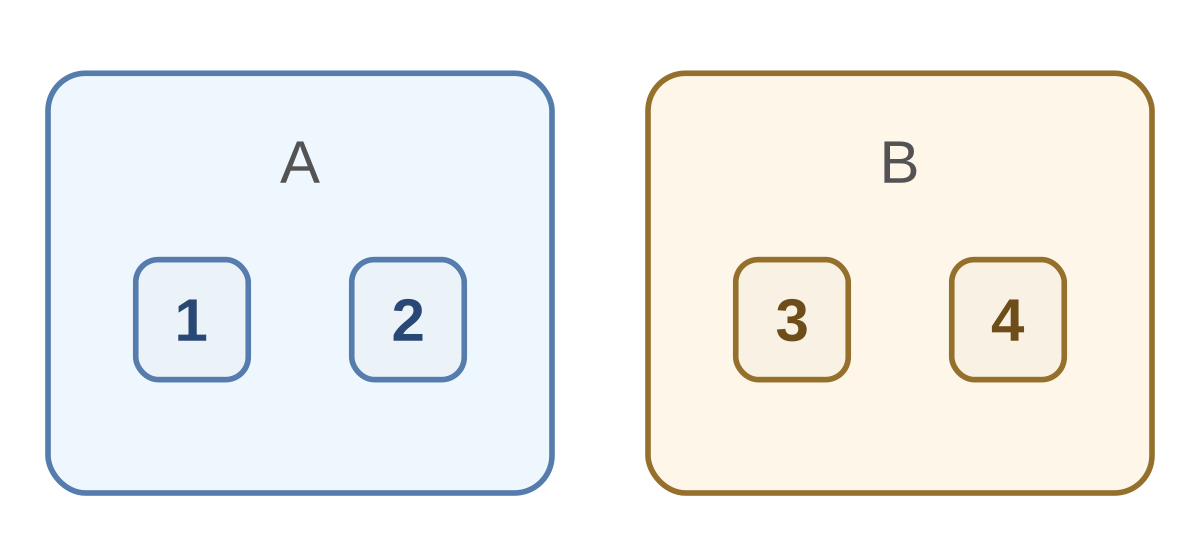
A = {1, 2} and B = {3, 4} have an empty intersection: no outcome lies in both.
The finite sample space contains 1, 2, 3, 4. A contains 1 and 2, B contains 3 and 4. No outcome belongs to both. The separate labeled enclosures express empty intersection, not probabilities or frequencies.The finite sample space contains 1, 2, 3, 4. A contains 1 and 2, B contains 3 and 4. No outcome belongs to both. The separate labeled enclosures express empty intersection, not probabilities or frequencies.
Figure 1The finite sample space contains 1, 2, 3, 4. A contains 1 and 2, B contains 3 and 4. No outcome belongs to both. The separate labeled enclosures express empty intersection, not probabilities or frequencies.
Link to this figure ↗Download SVGDownload PNG
Check your reasoning

A = {1, 3}. B = {3, 4}. Give verdict and full intersection.

  1. ADisjoint: {}.
  2. BOverlap: {1}.
  3. COverlap: {3}.
Show answer and explanation
Overlap: {3}.

The intersection is {3}.

02A record can satisfy two descriptions at once#

A record can satisfy two descriptions at once. “Red” and “round” overlap if at least one allowed record is both. Check the same trial, not two separate draws.

Check your reasoning

All records: u=red/round; v=blue/square. A means red; B means square. Disjoint?

  1. AOverlap: {u}.
  2. BDisjoint: {}.
  3. COverlap: {u, v}.
Show answer and explanation
Disjoint: {}.

No shared record.

03Different event names do not imply disjointness#

Different event names do not imply disjointness. If A = {1, 2} and B = {2, 3}, observing 2 makes both occur. Check membership regardless of the outcomes’ chances.

Check your reasoning

A = {2, 4}. B = {4, 6}. “Different sets, so disjoint.” Repair this claim.

  1. AOverlap: {4}.
  2. BDisjoint: {}.
  3. COverlap: {2}.
Show answer and explanation
Overlap: {4}.

The intersection is {4}.

Key takeaway

Look for a shared outcome. One is enough to rule out disjointness; an empty intersection confirms it.

Sources & further reading

  1. [1]
    Pishro-Nik, Introduction to Probability, 1.3.1 Random ExperimentsPishro-Nik, Introduction to Probability · Book

Reference this concept

Link to this page, a section, or an individual figure.

Glacius. “Disjoint events.” Math behind ML. /learn/p-disjoint