Random variables
A random variable is a real-valued function on the sample space.
On this page 7 sections
01A random variable assigns a number to every possible outcome of an experiment#
A random variable assigns a number to every possible outcome of an experiment. The rule is fixed; the outcome determines which assigned number you observe.
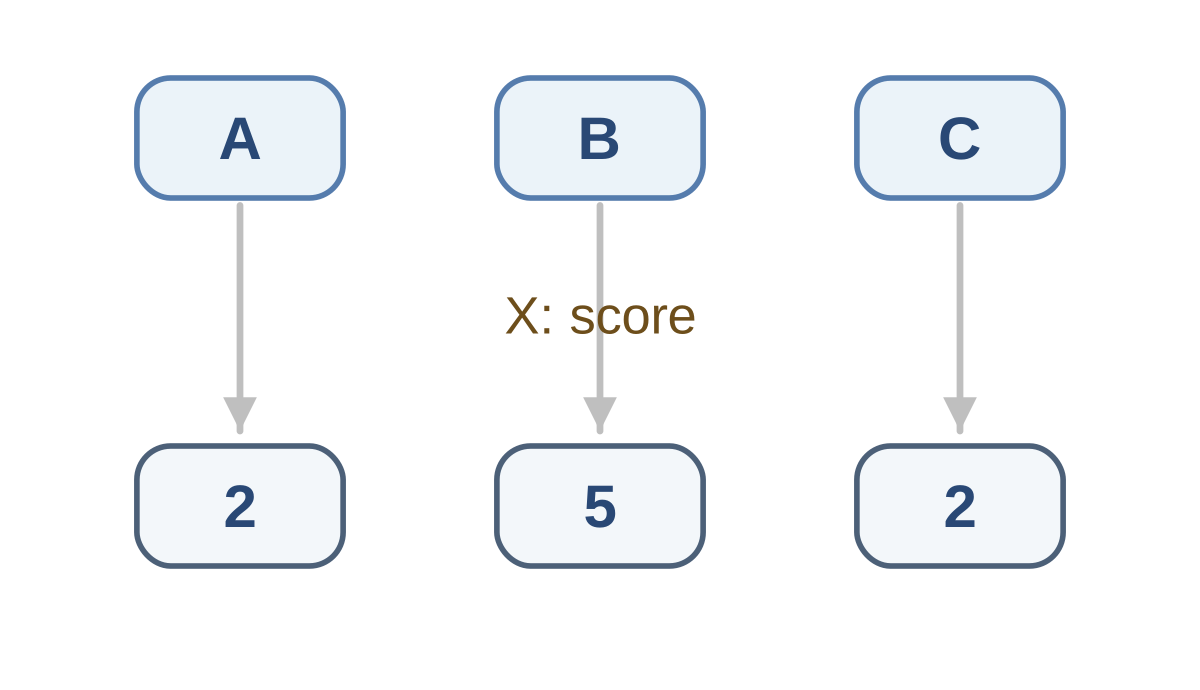
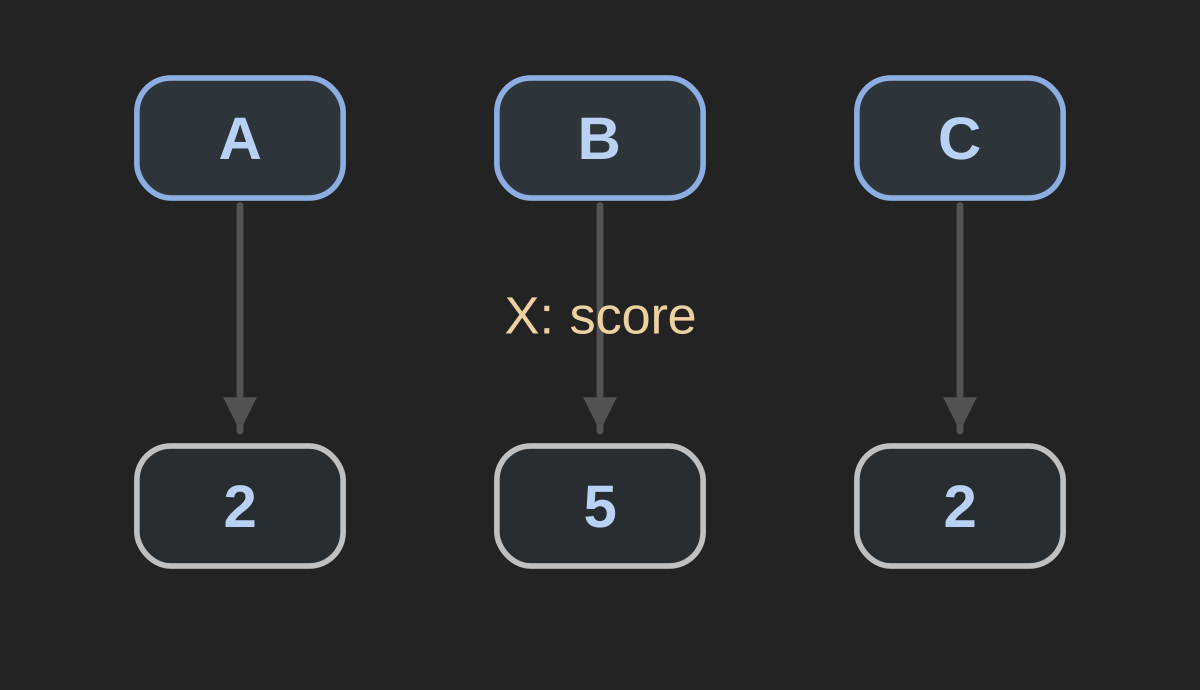
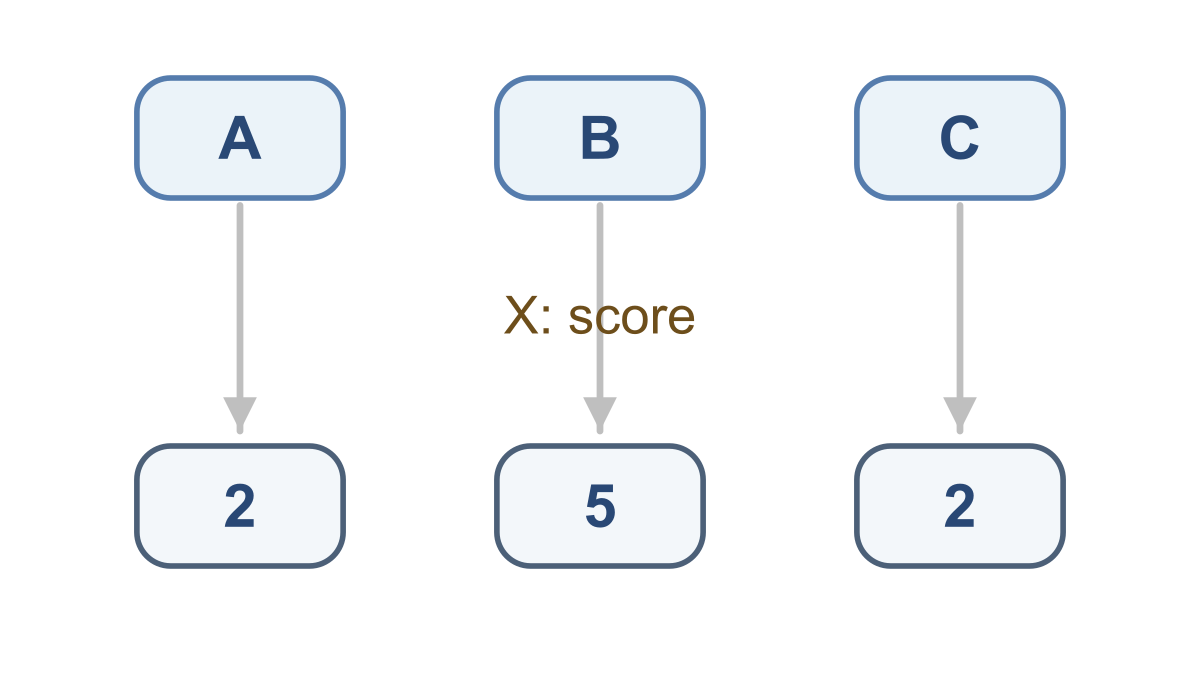
Here , , and . Before observing the outcome, is the whole mapping. If outcome occurs, the realized value is .
The possible numerical values are 2 and 5. Repeated outputs are allowed.
Outcomes: . . Give outputs in this order.
Show answer and explanation
Squares: .
02An outcome can be a whole record#
An outcome can be a whole record. Choosing one numerical field, such as its score, defines a random variable on those records.
Specify one number for every outcome. The mapping does not need to assign different numbers to different outcomes.
Records A, B, C have scores , , , respectively. Define as the score. Give .
Show answer and explanation
Scores: .
03The letter names the rule; a lowercase often names one possible value#
The letter names the rule; a lowercase often names one possible value. A single observed number does not specify the whole random variable.
To check a proposed map, go through the entire sample space and apply the stated rule to each outcome.
Outcomes: . . A map gives . Repair its output triple.
Show answer and explanation
Squares: .
Define one numerical value for every outcome; a realized value is only one result of that map.
- Define a numerical random variable on a finite sample space.
Sources & further reading
- [1]Pishro-Nik, Introduction to Probability: Random Variables ↗Pishro-Nik: Introduction to Probability · Article