Union probabilities
The probability of a two-event union is the sum of the event probabilities minus their intersection probability.
On this page 7 sections
01The union A ∪ B means A or B, including both#
The union A ∪ B means A or B, including both. An outcome in the overlap belongs to the union just once.
Here A has mass 0.5 and B has 0.4. Adding counts the shared 0.3 twice, so subtract one copy: 0.9 − 0.3 = 0.6.
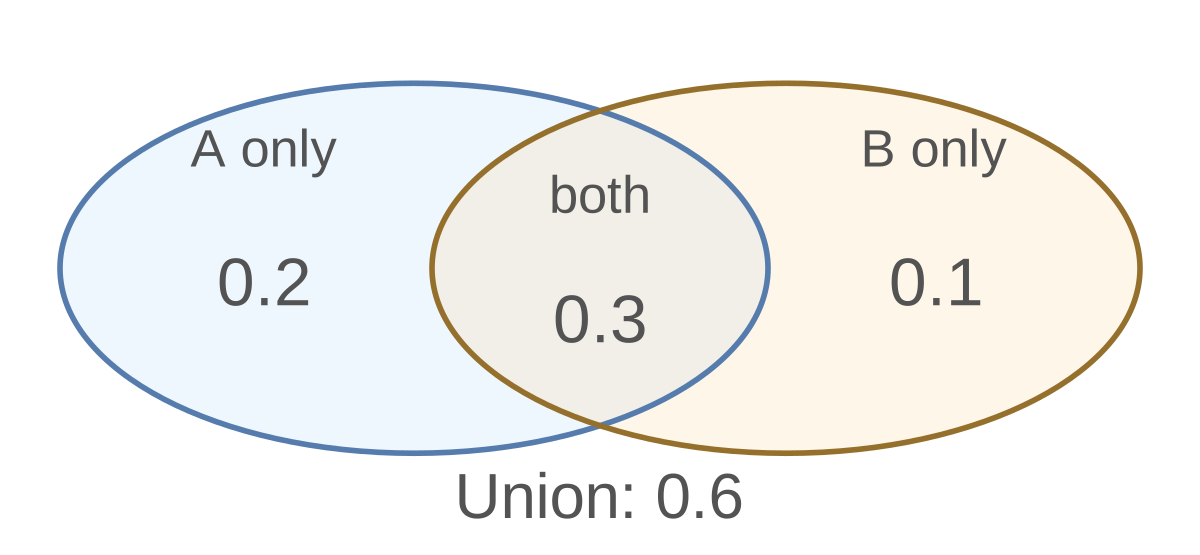
For the probability of :
Subtract only the overlap that was counted twice. With no overlap, there is nothing to subtract.
P(A)=0.5, P(B)=0.4, P(A∩B)=0.2. Find P(A∪B).
Show answer and explanation
0.5 + 0.4 − 0.2 = 0.7.
02For a uniformly selected record, the same correction applies to counts#
For a uniformly selected record, the same correction applies to counts. With 12 in A, 9 in B and 3 in both, 18 distinct records belong to either event.
Choose one of 40 records uniformly. 16 have A, 12 have B, and 4 have both. Find P(A or B), including both.
Show answer and explanation
24 distinct records qualify; divide by 40.
03Check your understanding#
P(A)=0.6, P(B)=0.5, P(A∩B)=0.2. A learner gives P(A∪B)=0.7. Repair it.
Show answer and explanation
0.6 + 0.5 − 0.2 = 0.9.
Add the two event probabilities, then subtract their shared mass once. The union includes outcomes in both events.
Sources & further reading
- [1]Philip B. Stark, SticiGui: Probability, Axioms and Fundaments ↗Philip B. Stark, UC Berkeley · Book