Event probabilities
For a finite sample space, an event probability is the sum of its distinct outcome masses.
On this page 7 sections
01An event’s probability is the total mass of its outcomes#
An event’s probability is the total mass of its outcomes. Distinct outcomes are alternatives for one trial, so their masses add.
Let A, B, C have masses 0.15, 0.5, 0.35. For E = {A, C}, select 0.15 and 0.35.
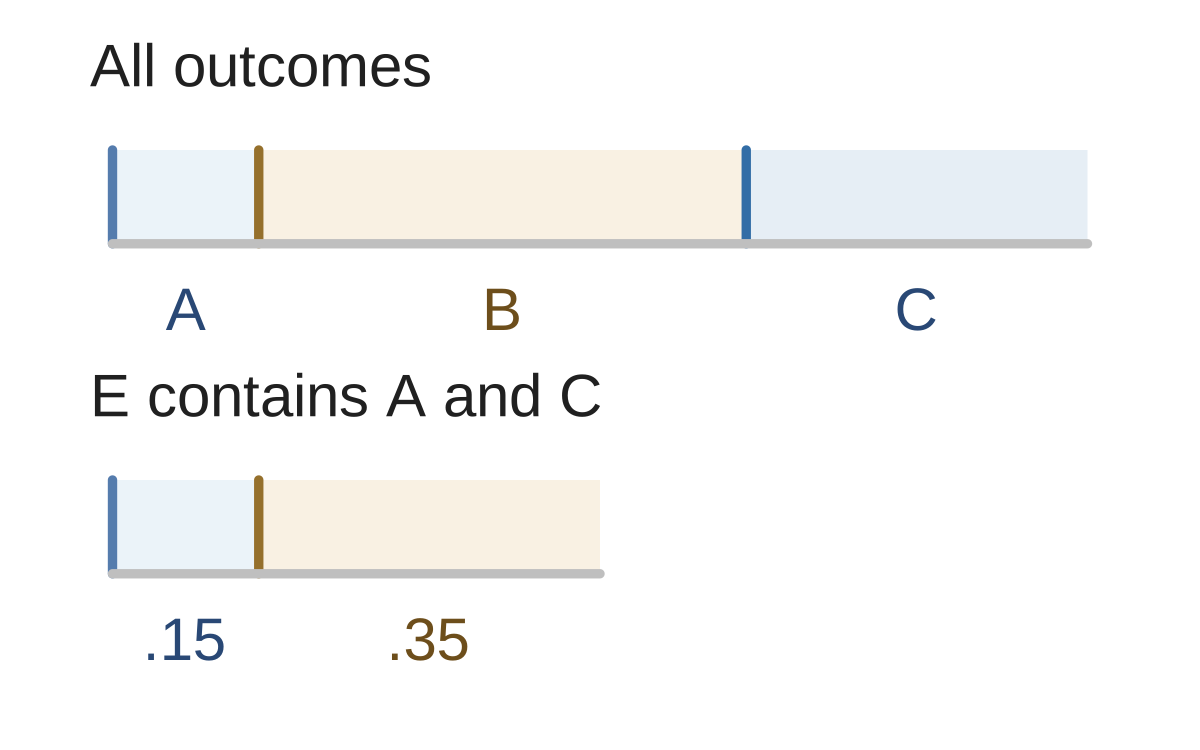
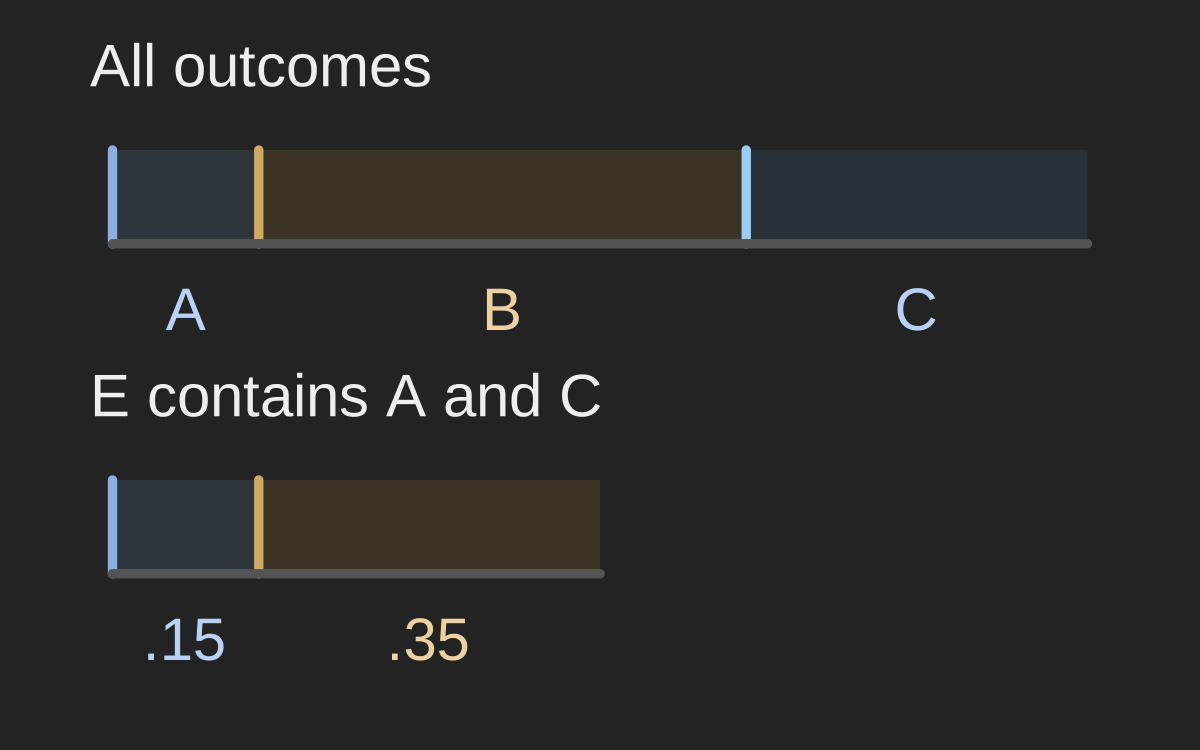
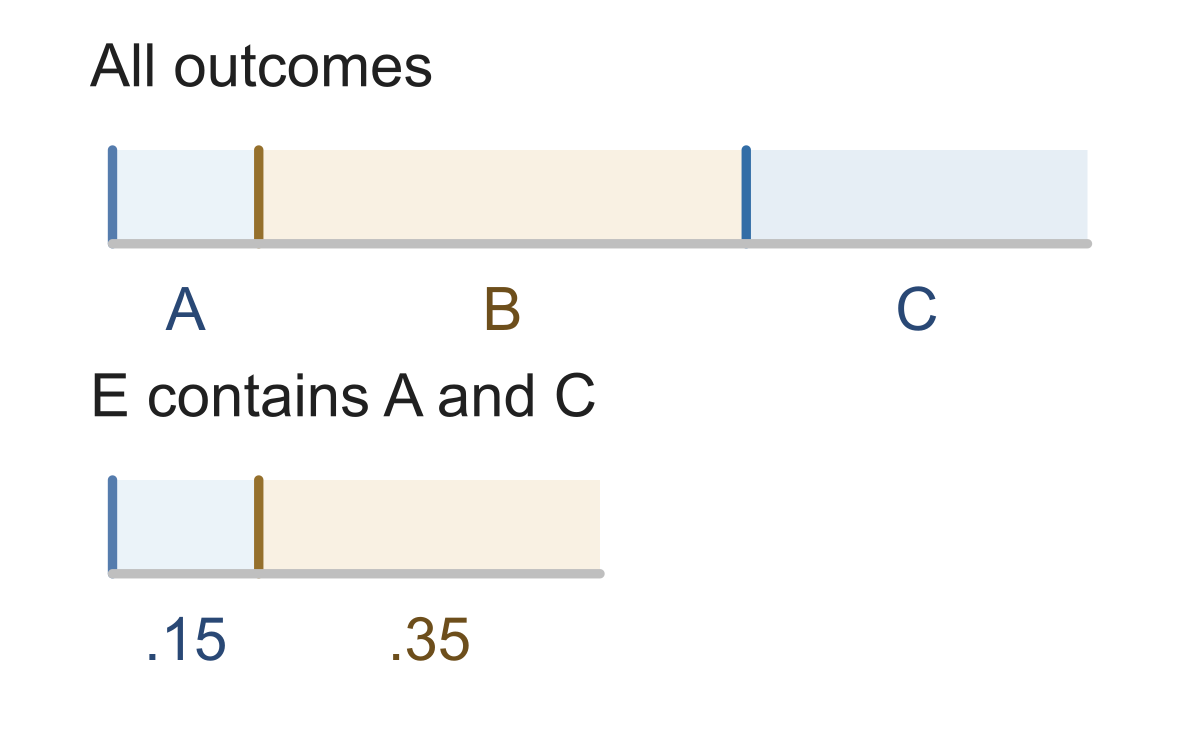
Masses: A=0.2, B=0.5, C=0.3. Event E = {A, C}. Find P(E).
Show answer and explanation
Add the masses of A, C: 0.5.
02If a model returns exactly one label, a group of labels is an event#
If a model returns exactly one label, a group of labels is an event. Add their supplied masses. The labels need not have equal chances.
A model returns one label. Masses: red=0.4, amber=0.35, green=0.25. An alert uses red or amber. Find its probability.
Show answer and explanation
Add the alert labels’ masses: 0.75.
03Counting favorable outcomes works only when every outcome has equal mass#
Counting favorable outcomes works only when every outcome has equal mass. With unequal masses, use the weights. Writing a label twice does not create a second outcome.
Masses: L=0.1, M=0.2, N=0.7. Event E = {L, M}. A learner gives P(E)=2/3. Repair it.
Show answer and explanation
0.1 + 0.2 = 0.3.
Select the event’s outcomes and add their masses once each. Use counts only when the underlying outcomes are equally likely.
Sources & further reading
- [1]Philip B. Stark, SticiGui: Probability, Axioms and Fundaments ↗Philip B. Stark, UC Berkeley · Book