MAP estimation
A posterior mode maximizes likelihood times prior over the supplied candidate set; all tied maxima are modes.
On this page 9 sections
01Understand the idea#
Maximum a posteriori, or MAP, estimation selects the parameter candidate with the greatest posterior probability. It combines the likelihood of the observed data with a prior preference over candidates. The candidate favored by data alone need not win after that prior is included.
The prior favors A, and likelihood favors C. Multiply their matching values: weights are 0.1,0.15,0.12. B has the largest posterior weight.
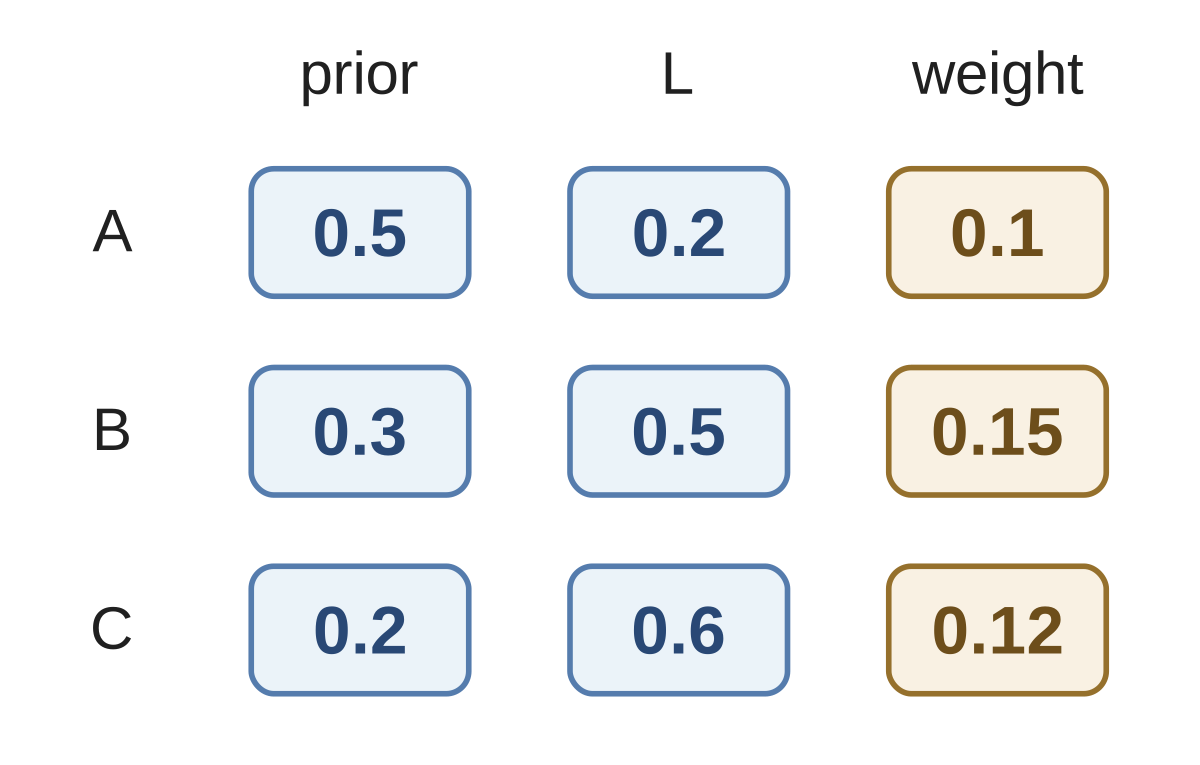
Every posterior mass has the same positive evidence denominator. For candidate , multiply its likelihood by prior . Choose every candidate tied at the largest weight.
For candidates A, B, C with prior and likelihood , multiply matching pairs to get . B has the greatest weight. All posterior masses would share the same positive normalization constant, so normalization is unnecessary if you only need the winner.
Candidates (A,B,C). Prior ; likelihood . Posterior mode?
Show answer and explanation
.
02For prior and likelihood , weights are #
For prior and likelihood , weights are . The second candidate wins even though its prior is smaller. Comparing just one input can change the answer.
Candidates (A,B,C). Prior ; likelihood . Claim: only A wins. Give all modes.
Show answer and explanation
.
03Keep all candidates tied at the largest weight#
Keep all candidates tied at the largest weight. A zero prior produces zero posterior weight when evidence is positive. Equal nonzero priors preserve likelihood ordering; unequal priors can change it.
Ordered iid Bernoulli sample , . ; prior . Posterior mode?
Show answer and explanation
04MAP reports a best candidate, not the full uncertainty over candidates#
MAP reports a best candidate, not the full uncertainty over candidates. Preserve all tied maxima when the task asks for every posterior mode. To answer a probability question about several candidate settings, retain and normalize the full grid instead.
Multiply each candidate’s likelihood by its prior and compare the weights. Keep every tied maximum.
- Select a posterior mode from a supplied likelihood and prior.
Further questions
How do we recover the whole posterior distribution?
Sources & further reading
- [1]
- [2]Pishro-Nik, §1.4.3 Bayes’ Rule ↗Textbook · Book