FoundationsConcept reference
Logarithms
A base-b logarithm of a positive number is the exponent to which a positive base other than one must be raised to obtain that number.
On this page 7 sections
01Since , the exponent that turns base 2 into 8 is 3#
Since , the exponent that turns base 2 into 8 is 3. We write , read “log base 2 of 8.”
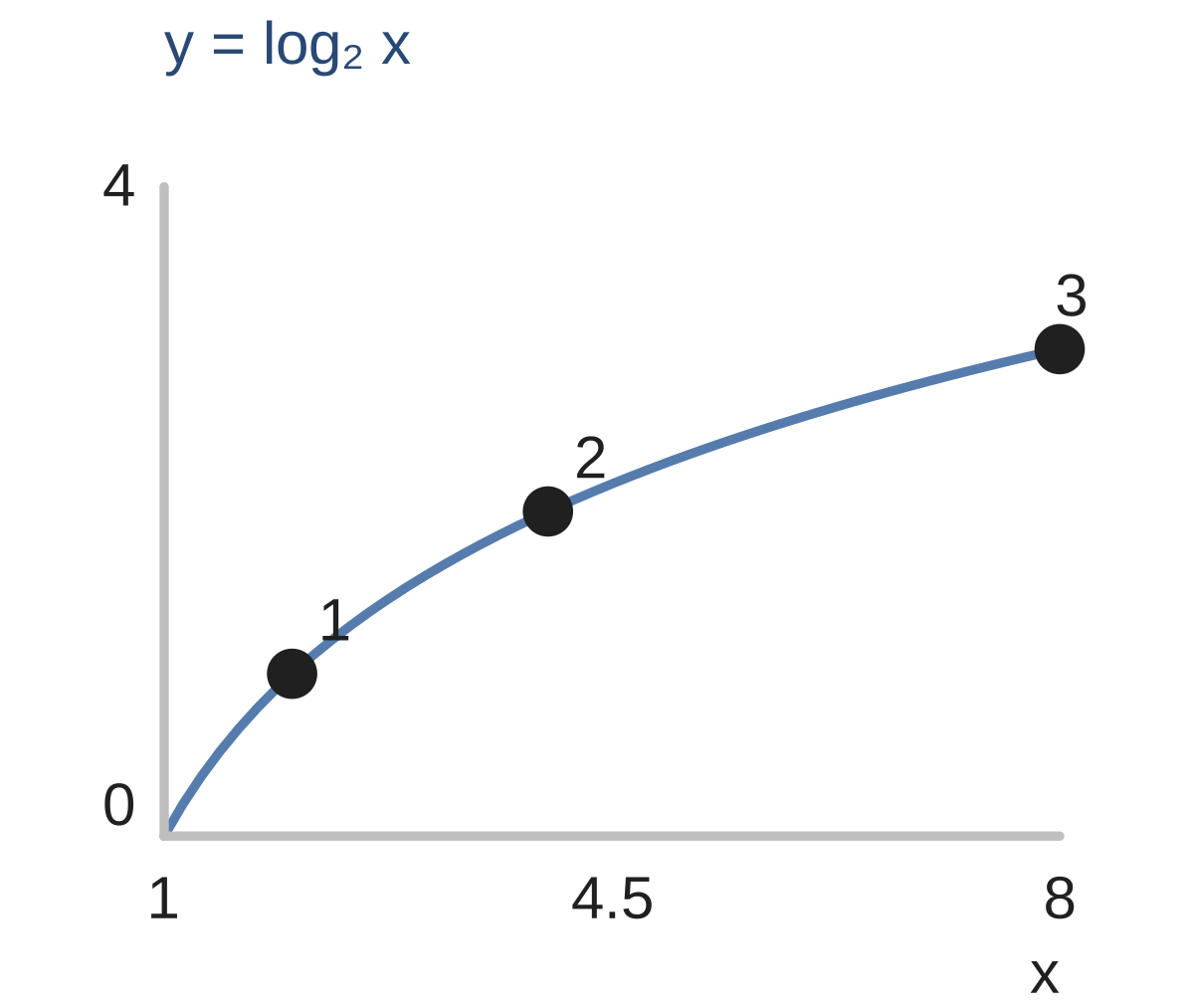
A logarithm asks the exponent question.
This means . Here, is the base, the argument, and the answer. For real logarithms, use , , and .
Check your reasoning
What is ?
Show answer and explanation
3
Because , the required exponent is 3.
02The answer can be zero or negative#
The answer can be zero or negative. Since , . Since , . The arguments stay positive in both cases.
Check your reasoning
What is ?
Show answer and explanation
-2
The exponent is −2 because .
03Check your understanding#
Check your reasoning
A quantity is multiplied by 3 each round. After how many rounds is it 81 times its starting value?
Show answer and explanation
4
The total multiplier after n rounds is . Since , it takes 4 rounds; this is .
Key takeaway
Ask which exponent makes the given base produce the argument.
- Evaluate a logarithm as an inverse exponent
Sources & further reading
- [1]OpenStax College Algebra 2e: 6 3 Logarithmic Functions ↗OpenStax · Book