Skip to content
Glacius
Linear algebraConcept reference

Linear independence

A vector list is linearly independent when its zero-combination equation has only the all-zero coefficient solution.

On this page 7 sections
  1. Overview
  2. For u=(1,0) and v=(0,1), the equation au+bv=0 becomes (a,b)=(0,0)
  3. A list containing the zero vector is dependent
  4. For u=(1,0), v=(0,1) and w=(1,1), no two vectors are multiples
  5. Key takeaway
  6. Sources & further reading
  7. Concept connections

01For u=(1,0) and v=(0,1), the equation au+bv=0 becomes (a,b)=(0,0)#

For u=(1,0)u=(1,0) and v=(0,1)v=(0,1), the equation au+bv=0au+bv=0 becomes (a,b)=(0,0)(a,b)=(0,0). Every coefficient must vanish.

This list is linearly independent: only the all-zero coefficient choice produces the zero vector.

Solve for real a,ba,b.

au+bv=0au+bv=0

All-zero coefficients are the trivial solution. A free coefficient permits a nonzero choice: dependence. No free coefficient means independence.
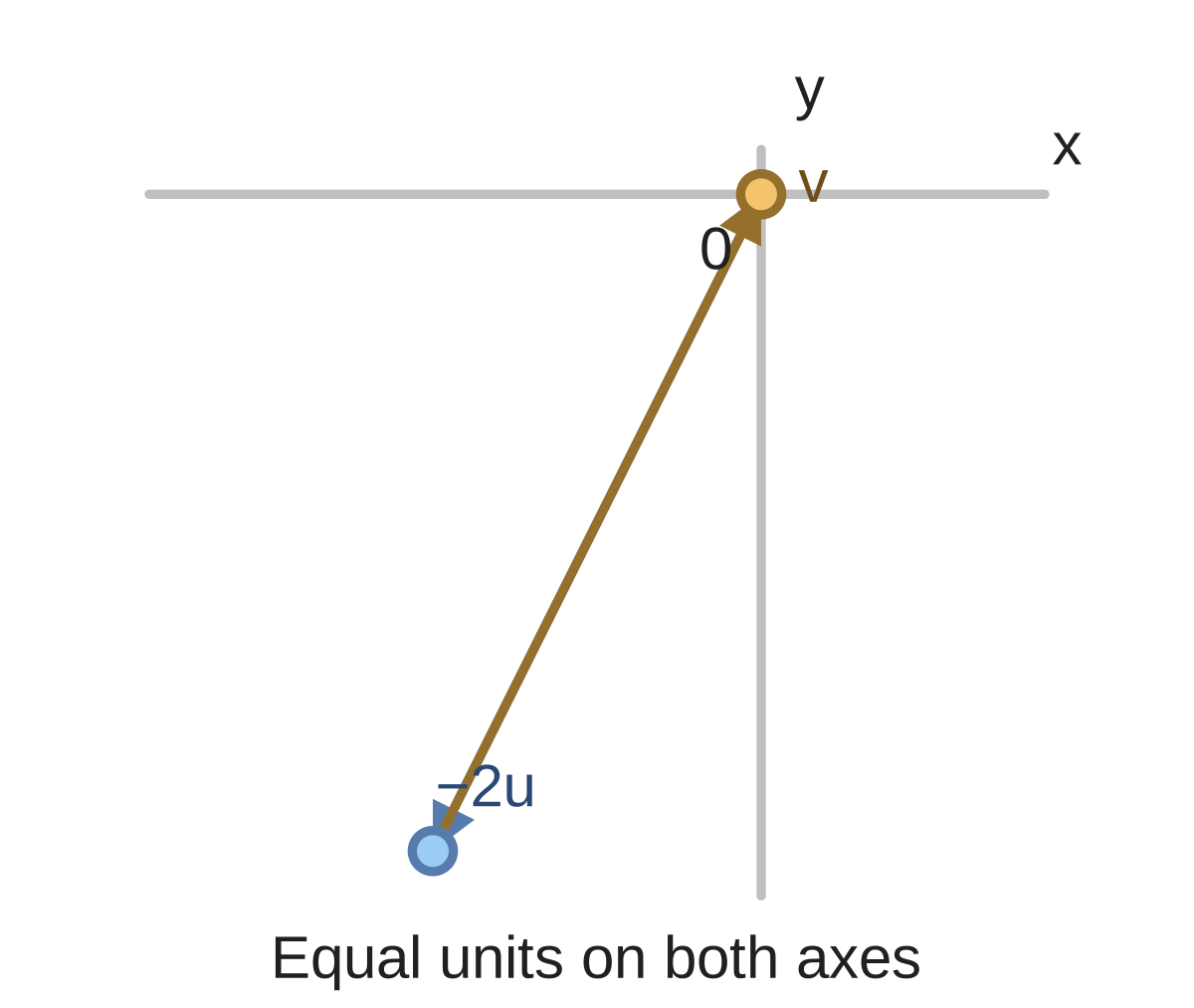
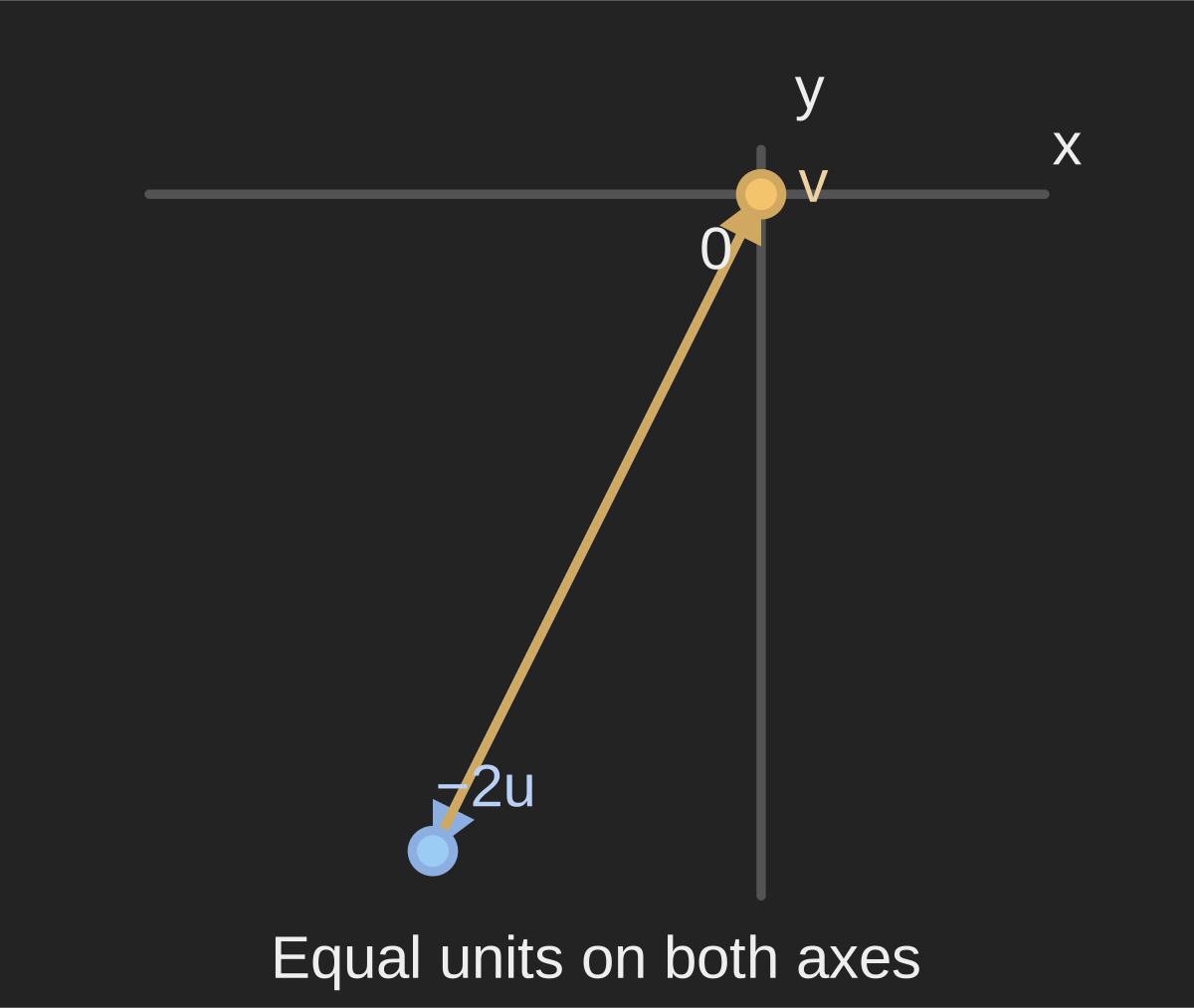
For u=(1,2) and v=(2,4), the arrow −2u ends at (−2,−4). Adding v returns to the origin. Coefficients (−2,1) are not both zero, so this is a nontrivial cancellation and the two-vector list is dependent.For u=(1,2) and v=(2,4), the arrow −2u ends at (−2,−4). Adding v returns to the origin. Coefficients (−2,1) are not both zero, so this is a nontrivial cancellation and the two-vector list is dependent.
Figure 1For u=(1,2) and v=(2,4), the arrow −2u ends at (−2,−4). Adding v returns to the origin. Coefficients (−2,1) are not both zero, so this is a nontrivial cancellation and the two-vector list is dependent.
Link to this figure ↗Download SVGDownload PNG

Here u=(1,2)u=(1,2) and v=(2,4)v=(2,4). Choosing coefficients (2,1)(-2,1) cancels both coordinates, so the list is dependent.

Check your reasoning

u=(1,3)u=(1,3), v=(2,6)v=(2,6). Which (a,b)(a,b) proves dependence via au+bv=0au+bv=0?

  1. A(0,0)(0,0)
  2. B(2,1)(-2,1)
  3. C(2,1)(2,1)
Show answer and explanation
(2,1)(-2,1)

2u+v=(2,6)+(2,6)=0-2u+v=(-2,-6)+(2,6)=0.

02A list containing the zero vector is dependent#

A list containing the zero vector is dependent. For u=(2,1)u=(2,1) and v=(0,0)v=(0,0), the coefficients (0,1)(0,1) give 0u+1v=00u+1v=0.

A dependence relation needs at least one nonzero coefficient. It need not use every vector.

Check your reasoning

Channels: A adds (1,0)(1,0), B adds (0,2)(0,2) per real weight. Nontrivial cancellation?

  1. ANo: only (0,0).
  2. BYes: weights (1,-1).
  3. CYes: weights (2,-1).
Show answer and explanation
No: only (0,0).

(a,2b)=0(a,2b)=0 forces a=b=0a=b=0.

03For u=(1,0), v=(0,1) and w=(1,1), no two vectors are multiples#

For u=(1,0)u=(1,0), v=(0,1)v=(0,1) and w=(1,1)w=(1,1), no two vectors are multiples. Yet u+vw=0u+v-w=0.

Checking each pair is insufficient for a larger list. Test the whole coefficient equation.

Check your reasoning

For u=(1,0),v=(0,1),w=(1,1)u=(1,0),v=(0,1),w=(1,1), refute Sam’s claim of independence.

  1. Auu and vv are different.
  2. B0u+0v+0w=00u+0v+0w=0.
  3. Cu+vw=0u+v-w=0.
Show answer and explanation
u+vw=0u+v-w=0.

The relation uses nonzero coefficients.

Key takeaway

Only the all-zero coefficient solution means independence.

  • Test independence using the whole zero-combination equation.

Sources & further reading

  1. [1]

Reference this concept

Link to this page, a section, or an individual figure.

Glacius. “Linear independence.” Math behind ML. /learn/la-independent