Skip to content
Glacius
Linear algebraConcept reference

Subspaces

A real subspace is a subset of real vectors containing zero and closed under addition and real scalar multiplication.

On this page 7 sections
  1. Overview
  2. Understand the idea
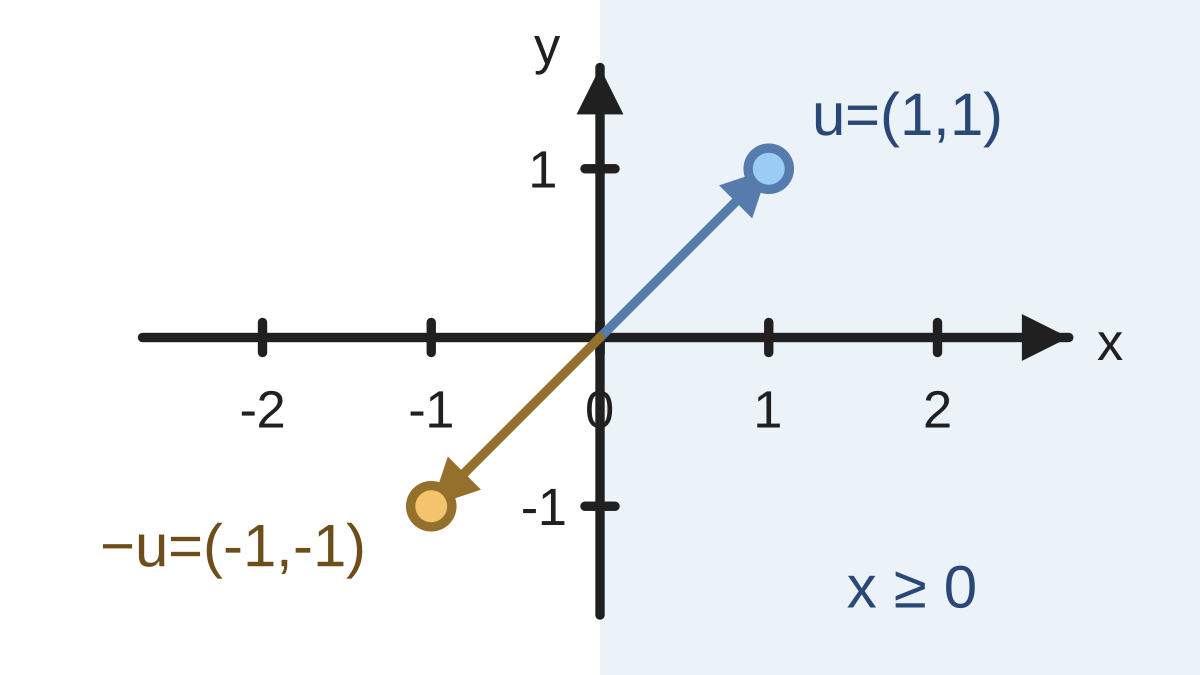
  3. The set xge0 contains u=(1,1) but excludes -u=(-1,-1)
  4. Check your understanding
  5. Key takeaway
  6. Sources & further reading
  7. Concept connections

01Understand the idea#

A real subspace is a set of vectors that contains zero and stays closed under addition and multiplication by every real scalar.

Closed means the result stays in the set. To prove closure, cover every allowed input. One valid counterexample disproves it.

Consider W={(t,2t):tR}W=\{(t,2t):t\in\mathbb R\}. Setting t=0t=0 includes zero. Take any two members (s,2s)(s,2s) and (t,2t)(t,2t).

Their sum stays in the same form.

(s+t, 2(s+t))(s+t,\ 2(s+t))

s+ts+t is real, so the sum belongs to WW.

For W={(t,2t):tR}W=\{(t,2t):t\in\mathbb R\}, take any real scalar cc.

Scaling also keeps the required form.

c(t,2t)=(ct,2ct)c(t,2t)=(ct,2ct)

The new parameter is real, including when c is zero or negative. All three conditions hold, so W is a subspace.

Check your reasoning

W={(t,2t):tR}W=\{(t,2t):t\in\mathbb R\}. For real cc, which result of c(t,2t)c(t,2t) stays in WW?

  1. A(ct,2ct)(ct,2ct)
  2. B(ct,2t)(ct,2t)
  3. C(t,2ct)(t,2ct)
Show answer and explanation
(ct,2ct)(ct,2ct)

ctct is real, so the defining form is preserved.

02The set xge0 contains u=(1,1) but excludes -u=(-1,-1)#

An equal-scale coordinate plot shades the half-plane x≥0. The vector u=(1,1) is inside it. Scaling by -1 gives -u=(-1,-1), outside it. The origin lies on the boundary, so containing zero does not rescue scalar closure. Each unit is 45 pixels on both axes.An equal-scale coordinate plot shades the half-plane x≥0. The vector u=(1,1) is inside it. Scaling by -1 gives -u=(-1,-1), outside it. The origin lies on the boundary, so containing zero does not rescue scalar closure. Each unit is 45 pixels on both axes.
Figure 1An equal-scale coordinate plot shades the half-plane x≥0. The vector u=(1,1) is inside it. Scaling by -1 gives -u=(-1,-1), outside it. The origin lies on the boundary, so containing zero does not rescue scalar closure. Each unit is 45 pixels on both axes.
Link to this figure ↗Download SVGDownload PNG

The set x0x\ge0 contains u=(1,1)u=(1,1) but excludes u=(1,1)-u=(-1,-1). It fails closure under real scaling, despite containing zero.

Check your reasoning

Are the signals (t,t)(t,t) for any real tt a subspace?

  1. ANo: negatives fail.
  2. BYes: 0,s+t,ctR0,s+t,ct\in\mathbb R.
  3. CYes: zero suffices.
Show answer and explanation
Yes: 0,s+t,ctR0,s+t,ct\in\mathbb R.

s+ts+t and ctct stay real.

03Check your understanding#

Check your reasoning

Claim: real pairs with x+y=1x+y=1 form a subspace. What refutes it?

  1. A(1,0)(1,0) satisfies it.
  2. BThere are two coordinates.
  3. CZero fails the rule.
Show answer and explanation
Zero fails the rule.

0+0=00+0=0, not 1.

Key takeaway

Check all three conditions, including negative and zero scalars.

  • Check the defining subspace conditions.

Sources & further reading

  1. [1]

Reference this concept

Link to this page, a section, or an individual figure.

Glacius. “Subspaces.” Math behind ML. /learn/la-subspace