Skip to content
Glacius
Linear algebraConcept reference

Span

The span of a vector list is the set of all its real linear combinations.

On this page 7 sections
  1. Overview
  2. The span of supplied vectors contains every combination made with real coefficients
  3. Using u=(1,0) and v=(2,0), both (a,c)=(2,0) and (0,1) produce (2,0)
  4. Check your understanding
  5. Key takeaway
  6. Sources & further reading
  7. Concept connections

01The span of supplied vectors contains every combination made with real coefficients#

The span of supplied vectors contains every combination made with real coefficients. It includes multiples, sums and zero.
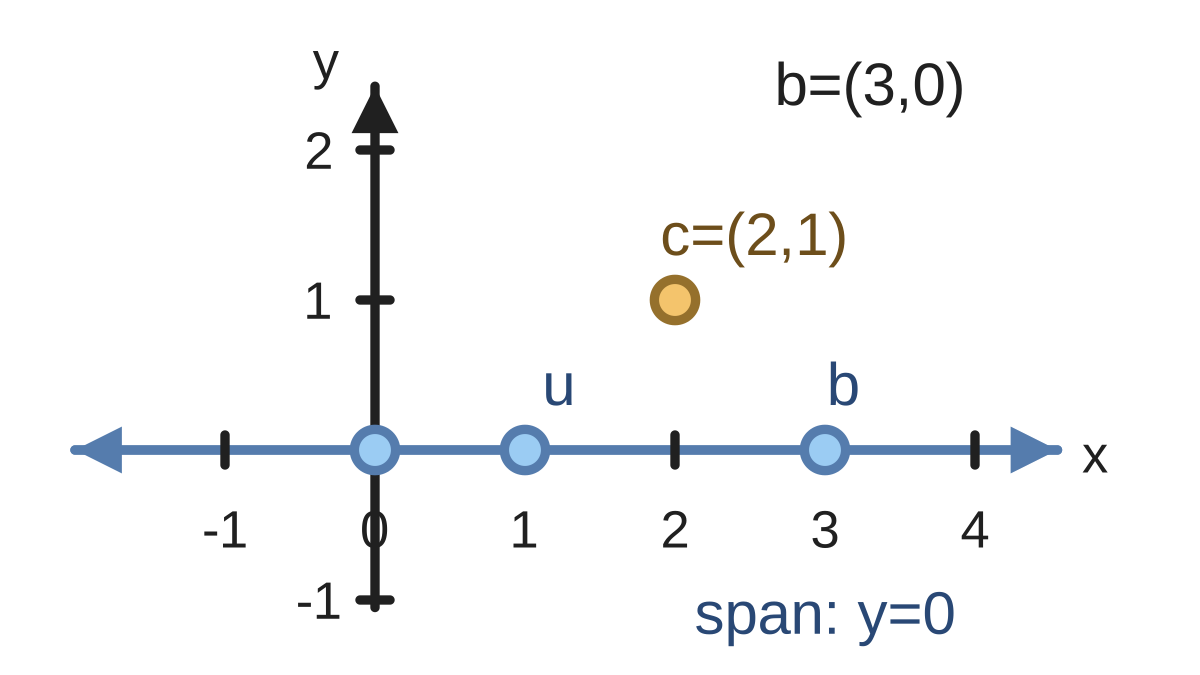
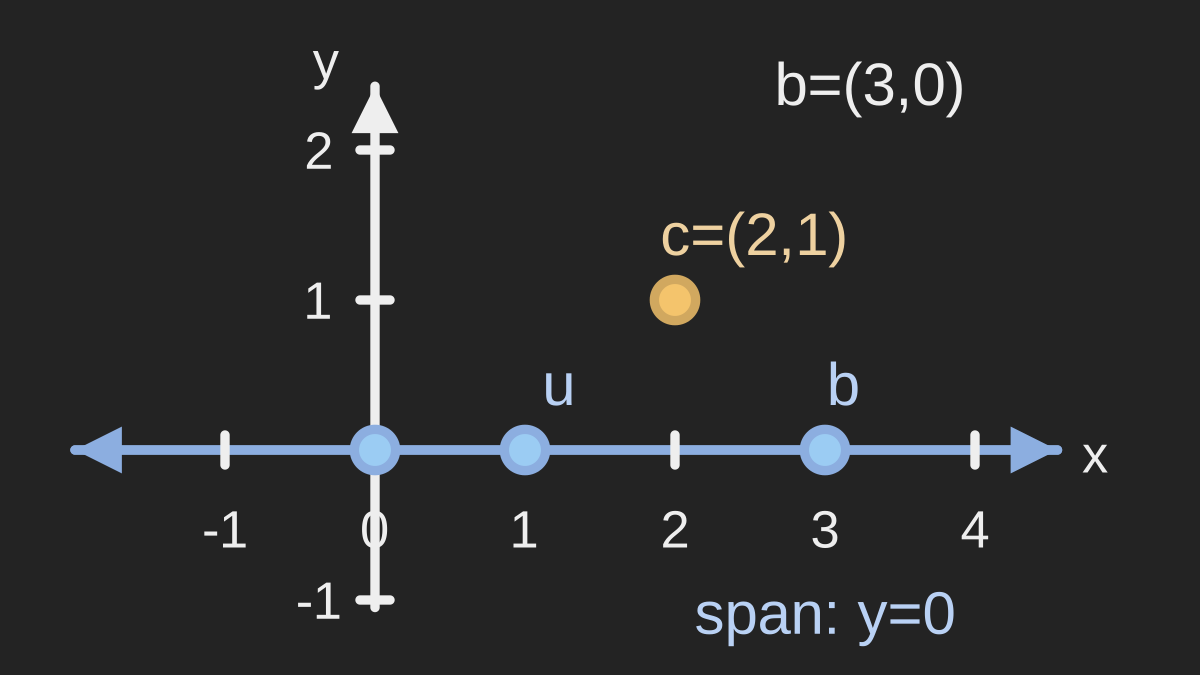
An equal-scale coordinate plot shows the entire horizontal line y=0 as the span of u=(1,0). The origin and b=(3,0) lie on it; c=(2,1) lies one unit above it, outside the span. Each coordinate unit is 40 pixels on both axes.An equal-scale coordinate plot shows the entire horizontal line y=0 as the span of u=(1,0). The origin and b=(3,0) lie on it; c=(2,1) lies one unit above it, outside the span. Each coordinate unit is 40 pixels on both axes.
Figure 1An equal-scale coordinate plot shows the entire horizontal line y=0 as the span of u=(1,0). The origin and b=(3,0) lie on it; c=(2,1) lies one unit above it, outside the span. Each coordinate unit is 40 pixels on both axes.
Link to this figure ↗Download SVGDownload PNG

Use u=(1,0)u=(1,0) and v=(1,2)v=(1,2). Test au+cv=(4,6)au+cv=(4,6).

Match coordinates.

a+c=42c=6\begin{gathered}a+c=4\\2c=6\end{gathered}

c=3c=3, then a=1a=1. Both coordinates match, so the target is in the span.

For u=(1,0)u=(1,0) and v=(2,0)v=(2,0), every combination is (a+2c,0)(a+2c,0). The target (3,1)(3,1) would require 0=10=1 in the second coordinate.

The coefficient system must match every target coordinate. Its consistency is exactly the test for span membership.

Check your reasoning

To reach (5,4)(5,4), solve a(1,0)+c(1,2)=(5,4)a(1,0)+c(1,2)=(5,4). What is aca-c?

Show answer and explanation
1

2c=42c=4 gives c=2c=2; a+c=5a+c=5 gives a=3a=3.

02Using u=(1,0) and v=(2,0), both (a,c)=(2,0) and (0,1) produce (2,0)#

Using u=(1,0)u=(1,0) and v=(2,0)v=(2,0), both (a,c)=(2,0)(a,c)=(2,0) and (0,1)(0,1) produce (2,0)(2,0).

One working choice proves membership. The coefficients need not be unique, nonnegative, or add up to one.

Check your reasoning

Per unit, A adds (1,0)(1,0) and B adds (0,2)(0,2). Can signed real settings produce (2,6)(-2,6)?

  1. AYes: A=2-2, B=33.
  2. BNo: negative settings fail.
  3. CYes: A=2-2, B=66.
Show answer and explanation
Yes: A=2-2, B=33.

(2,23)=(2,6)(-2,2\cdot3)=(-2,6).

03Check your understanding#

Check your reasoning

u=(1,2)u=(1,2). Rae excludes (0,0)(0,0) from its span. Refute this.

  1. AOnly uu belongs.
  2. BEvery vector fits.
  3. C0u=(0,0)0u=(0,0).
Show answer and explanation
0u=(0,0)0u=(0,0).

Use coefficient 0.

Key takeaway

Find one coefficient choice that matches every coordinate.

  • Test membership by matching all coordinates.

Sources & further reading

  1. [1]

Reference this concept

Link to this page, a section, or an individual figure.

Glacius. “Span.” Math behind ML. /learn/la-span