Conditional mass functions
A joint mass table assigns probabilities to pairs of values.
On this page 7 sections
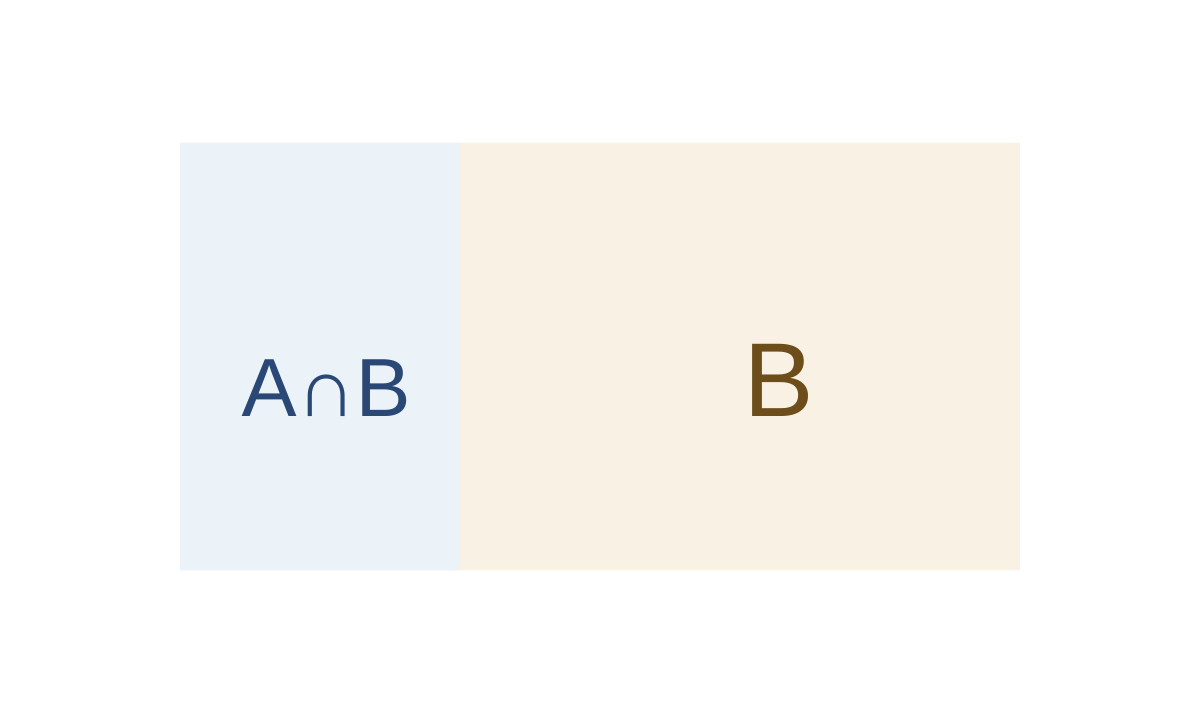

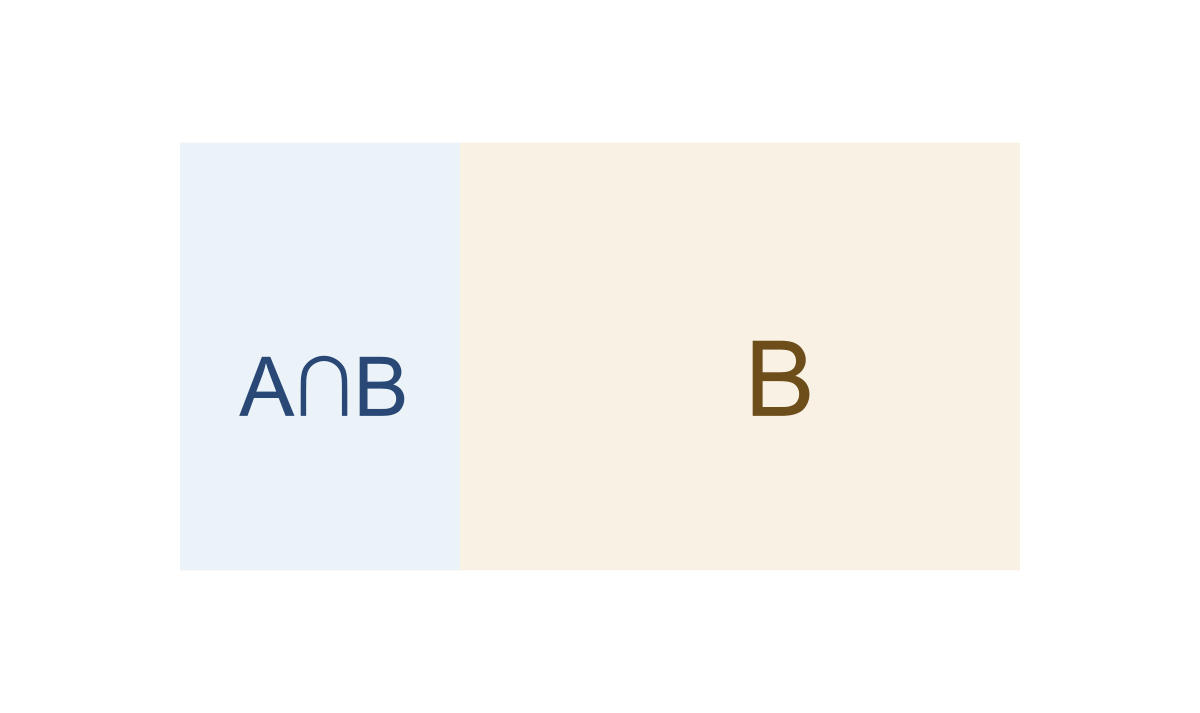
01Keep only the observed case#
A joint mass table assigns probabilities to pairs of values. After observing one variable, a conditional distribution keeps that variable's slice and renormalizes it to total probability one.
Suppose a joint table has columns and rows . Row has masses ; row has masses . All four masses sum to one.
02Divide by the slice's mass#
Observing restricts us to total mass . Dividing each entry in that row by gives conditional probabilities for .
The conditional masses sum to . The original joint row sums to . Keeping its entries unchanged would describe joint events, not probabilities within the observed case.
Joint table columns X=0,1; row Y=a has masses (0.1,0.3), row Y=b has (0.2,0.4). Find P(X=1 | Y=a).
Show answer and explanation
The observed row has total mass 0.4; divide 0.3 by 0.4.
03Conditioning on a column is different#
If instead you observe , the selected column has total mass . The conditional probabilities for become . The question determines which variable is fixed and which values remain possible.
A joint row sums to 0.4. A draft calls its unchanged entries a conditional distribution. What is missing?
Show answer and explanation
Conditioning rescales the selected slice to total probability one.
This finite-table ratio requires the conditioning case to have positive probability. A zero-mass slice cannot be normalized by dividing by zero. Zero entries within a positive-mass slice are fine and remain zero.
Compute a conditional distribution from a joint mass table.
- Compute a conditional distribution from a joint mass table.
Sources & further reading
- [1]Dive into Deep Learning, §2.6 Probability and Statistics ↗d2l.ai · Article
- [2]Harvard Stat 110, Strategic Practice 10 (2011) ↗stat110.hsites.harvard.edu · Article
- [3]Harvard Stat 110, Strategic Practice and Homework 9 (2011) ↗stat110.hsites.harvard.edu · Article