Conditional probability
Conditional probability within a positive-probability event is intersection probability divided by conditioning probability.
On this page 8 sections
01New information changes which outcomes are relevant#
New information changes which outcomes are relevant. Conditional probability measures the share of an event inside the population retained by a condition. The vertical bar in means “given ”; the event after the bar chooses the denominator.
Conditional probability asks for the chance of A within event B. Keep only B’s outcomes; B becomes the whole you compare against.
B contains masses 0.2 and 0.3, so its total is 0.5. A selects the first outcome. Its share within B is 0.2 / 0.5 = 0.4.
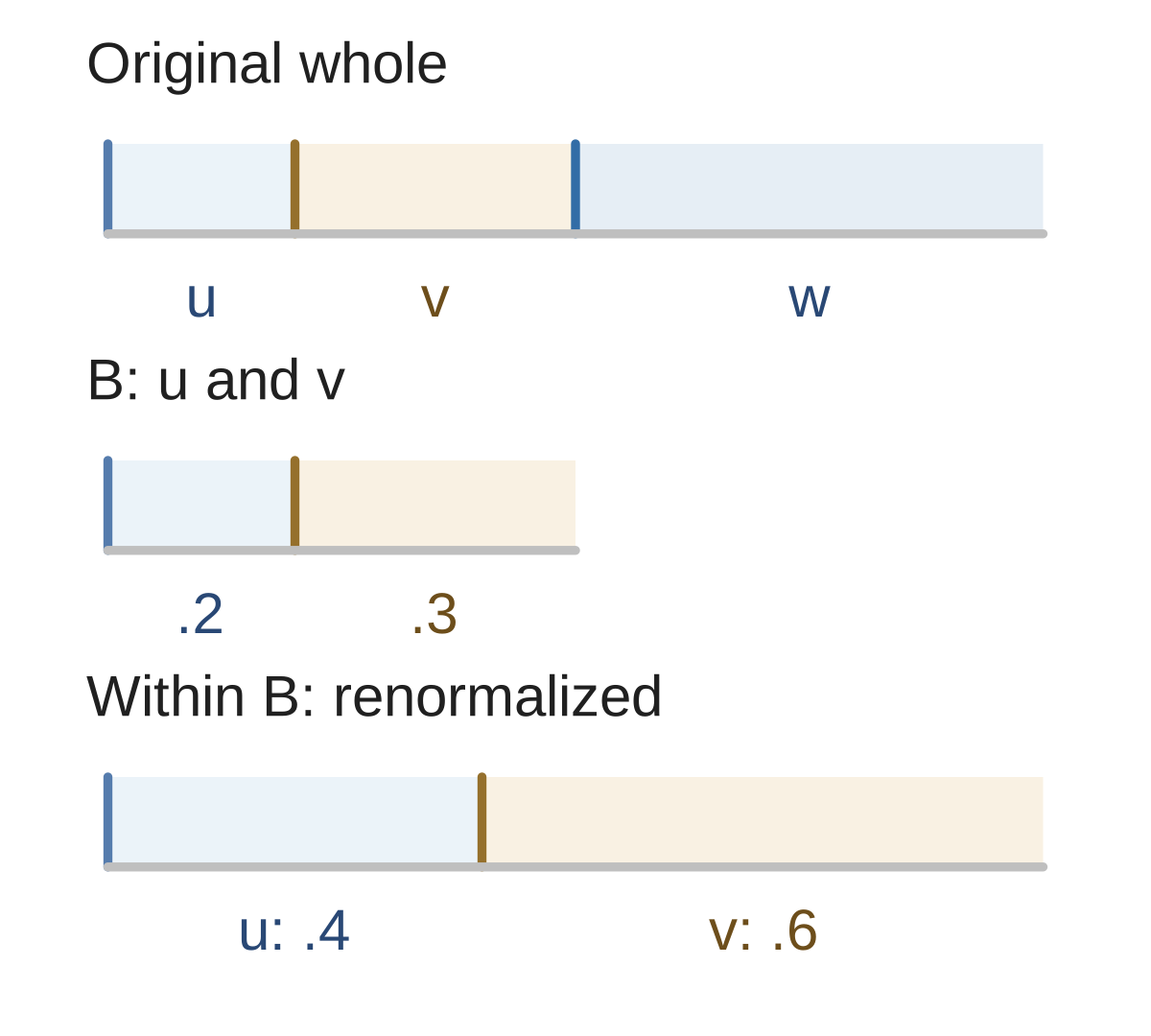
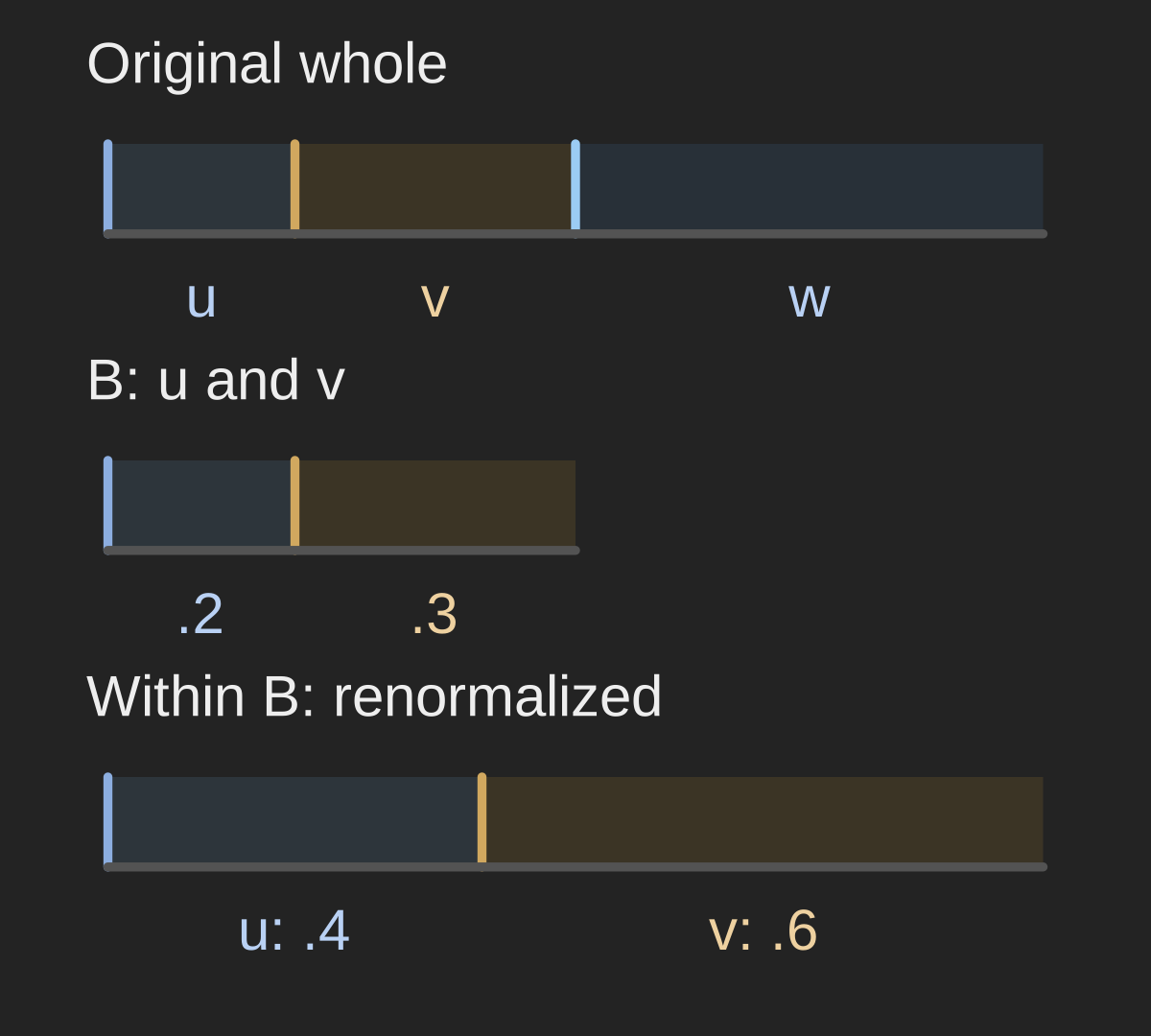
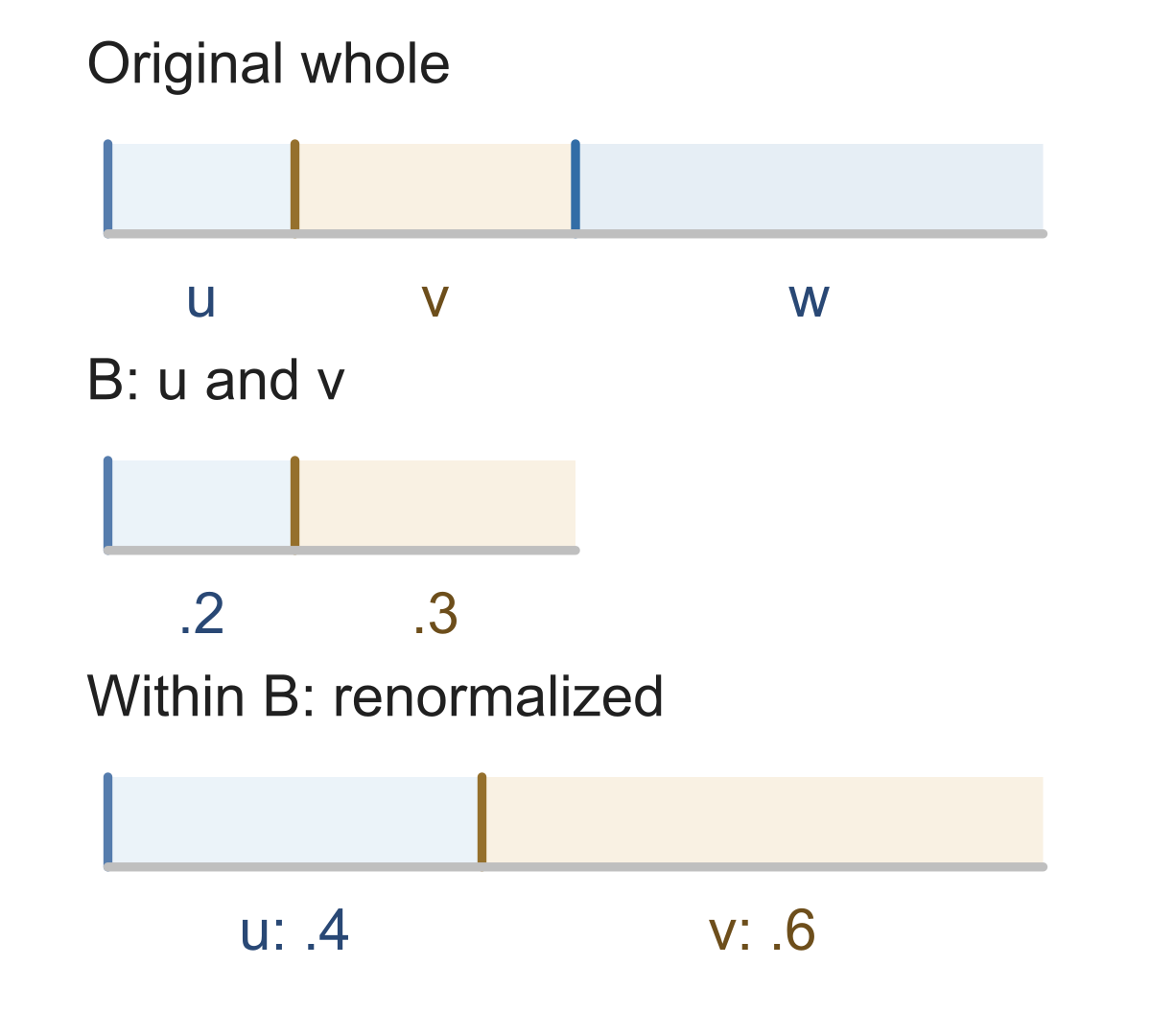
Among 100 equally weighted records, suppose 40 have property , and 12 of those also have . After learning , compare 12 with 40: . Dividing by 100 would give the chance of both properties before conditioning, not the chance of among the retained records.
For :
The numerator is shared mass. The denominator is B’s mass and must be positive.
P(A)=0.5, P(B)=0.8, P(A∩B)=0.4. Find P(A | B).
Show answer and explanation
0.4 / 0.8 = 0.5.
02A closer look#
For uniform records, divide the number satisfying both conditions by the number satisfying B. For unequal outcome masses, add the retained weights before dividing.
Choose one of 50 records uniformly. 20 have B; 15 of those also have A. Given B, find P(A | B).
Show answer and explanation
Within B, 15 of 20 qualify: 0.75.
03A closer look#
A condition with zero probability gives a zero denominator, so this ratio does not define a conditional probability. A zero numerator with a positive denominator simply gives 0.
P(A)=0.5, P(B)=0.4, P(A∩B)=0.1. A learner gives 0.1 for P(A | B). Repair it.
Show answer and explanation
Divide shared mass by P(B): 0.25.
04A classifier’s error rate within one subgroup is a conditional rate#
A classifier’s error rate within one subgroup is a conditional rate. Comparing subgroup rates requires keeping each subgroup’s denominator straight. These rates describe an association within the specified data; conditioning alone does not establish causation.
Restrict to the given condition, then compare the shared mass with that condition’s total. The conditioning mass must be positive.
Sources & further reading
- [1]Philip B. Stark, SticiGui: Probability, Axioms and Fundaments ↗Philip B. Stark, UC Berkeley · Book