Holdout evaluation
A holdout set stays outside fitting and selection until the model is frozen.
On this page 7 sections
01A holdout set evaluates a model on observations that did not shape it#
A holdout set evaluates a model on observations that did not shape it. Use training data to fit the model. Freeze the complete procedure before reading the final holdout results. Here the observations are independent draws from the target distribution.
Train on a, b, c, and reserve d, e. After freezing the model, suppose the two holdout losses are 1 and 5. Its holdout mean loss is .
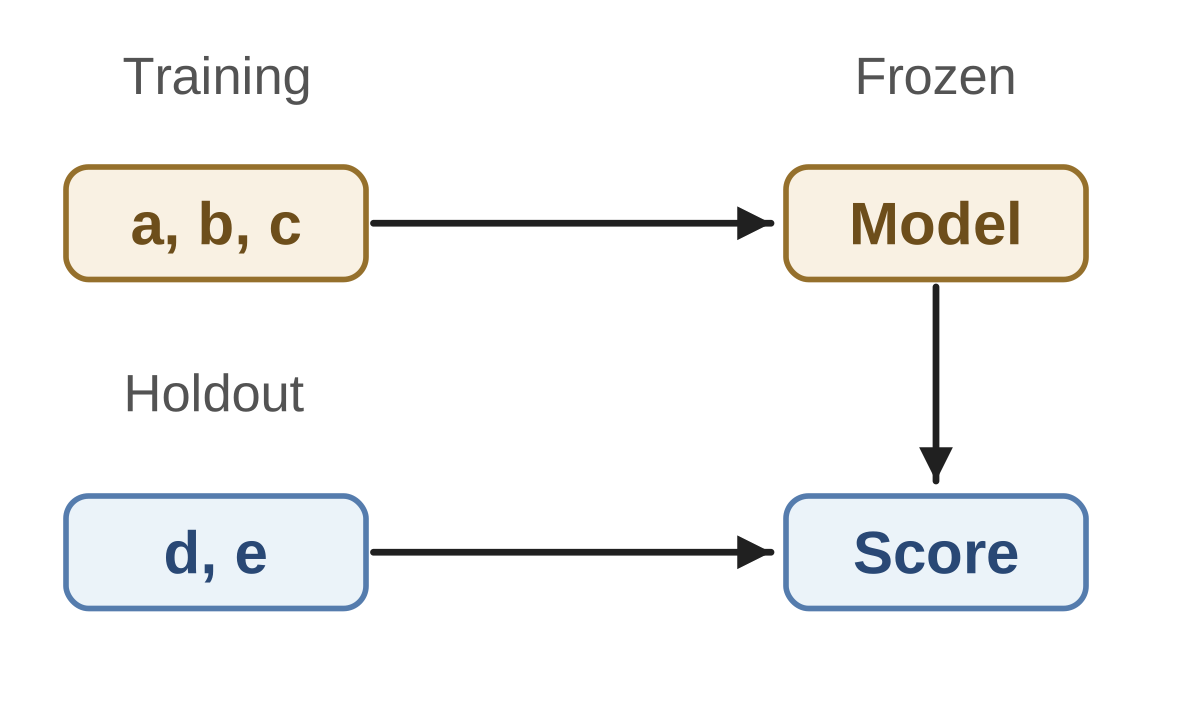
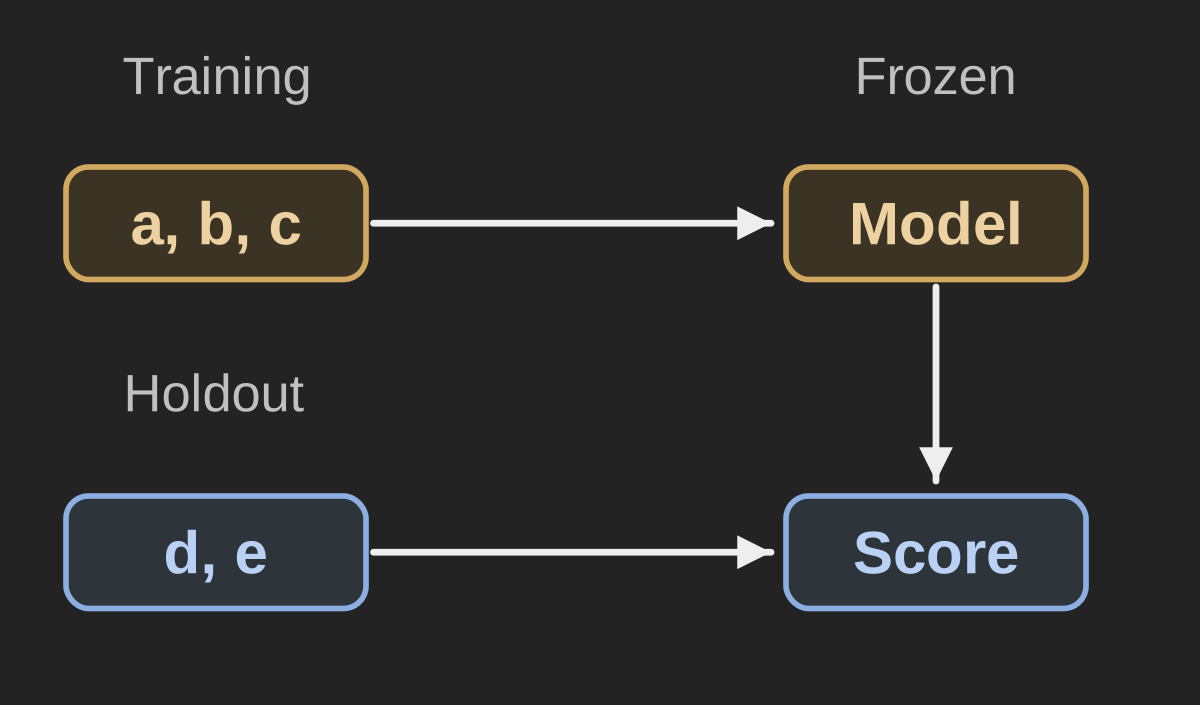
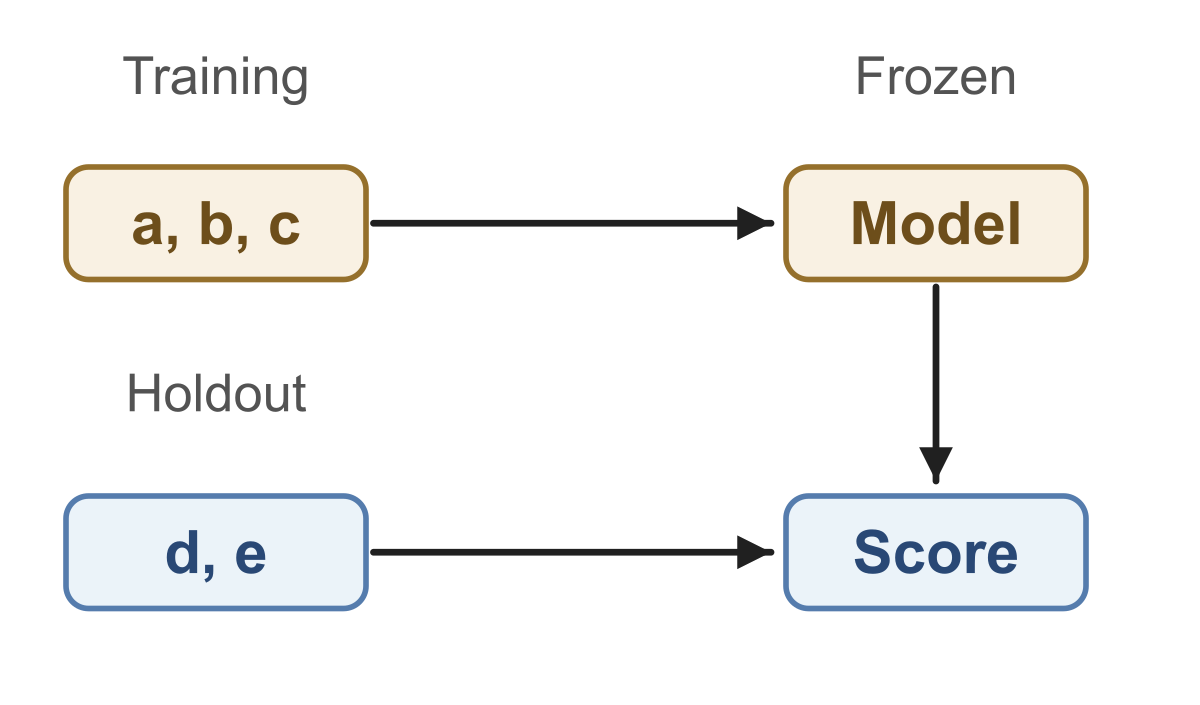
Frozen model. IID records (T=fit, H=untouched): a:T:1, b:H:2, c:H:6. Values are losses. Holdout mean?
Show answer and explanation
Holdout loss: 2+6; divide by 2.
02Choosing settings also shapes the model#
Choosing settings also shapes the model. A validation block can guide those choices, but a separate test block must remain untouched for final evaluation. Calling a reused block “test” does not restore independence.
Independent IID blocks A,B,C. Fit on B; choose settings on C. Freeze. Untouched final evaluation block(s)?
Show answer and explanation
A is still unused.
03A closer look#
A model can fit training data unusually well, so training loss alone is not a fresh evaluation. A holdout mean is still a sample result, not an exact future error. Its relevance also depends on evaluating the population the model will face.
Independent IID blocks K,L,M. Fit on L; choose settings on K. Freeze. “K is untouched.” Final block?
Show answer and explanation
M is still unused.
Trace every use of the data. Freeze fitting and selection, then average losses on the untouched target-distribution observations.
- Separate fitting and selection from final evaluation.
Sources & further reading
- [1]Scikit-learn User Guide, Cross-validation: Evaluating Estimator Performance ↗Scikit-learn developers · Article