Null hypotheses
A null and alternative are statements about a population parameter; complementary hypotheses divide the allowed parameter values into the reference claim and the investigated alternative.
On this page 7 sections
01Hypotheses state claims about a population parameter#
Hypotheses state claims about a population parameter. Here is the direction being investigated; contains the remaining allowed values. These complementary hypotheses never overlap and cover the parameter model.
Suppose can be . To investigate , use and . Equality belongs to the null.
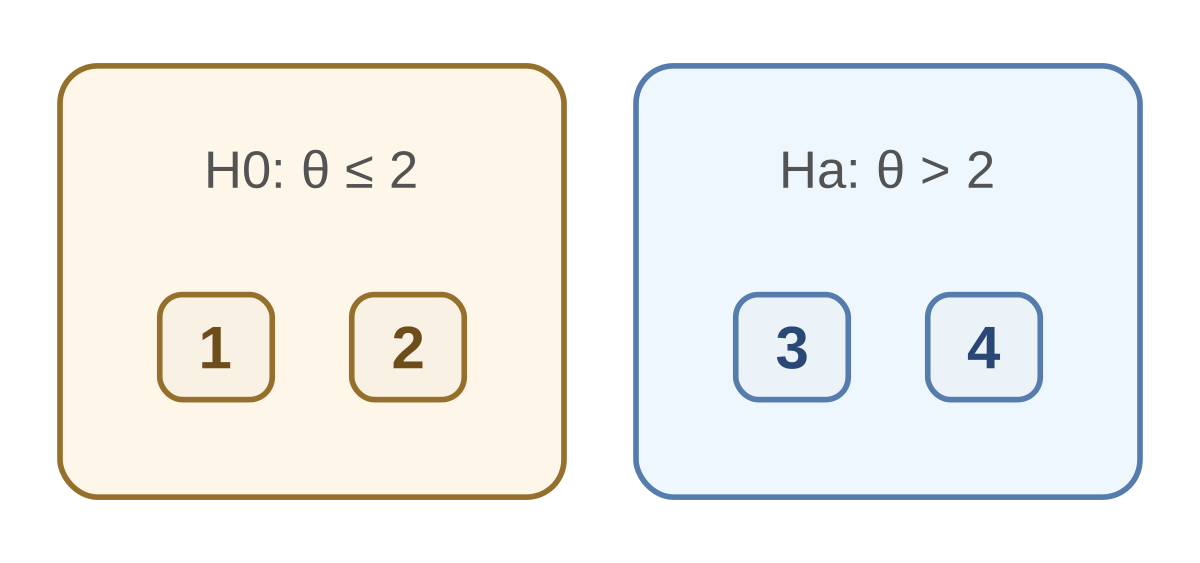
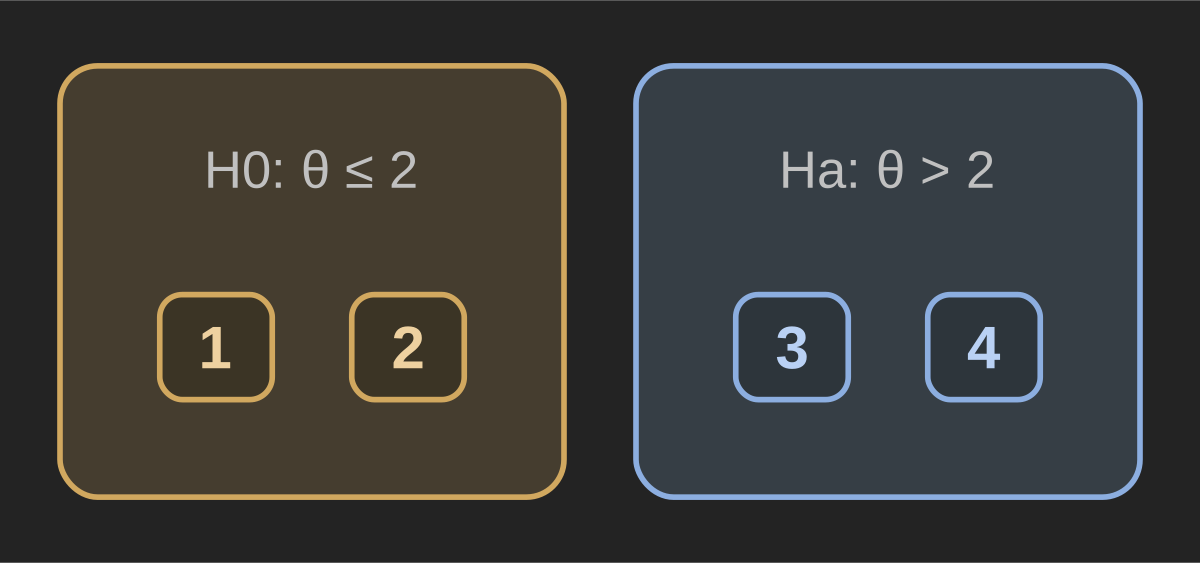
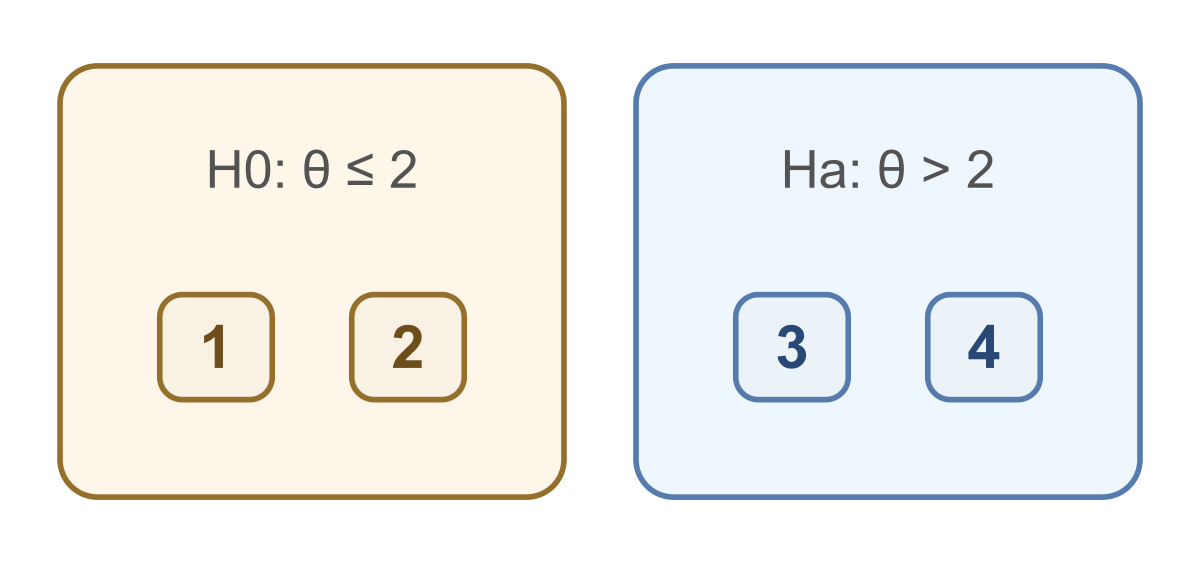
μ: population mean. Investigate μ below 5. Complementary H0 / Ha?
Show answer and explanation
Ha: μ<5; H0 is its complement.
02For a population mean , “different from 6” gives and #
For a population mean , “different from 6” gives and . The sample mean is evidence about , not the parameter named in these hypotheses.
p: population proportion; p̂: sample value 0.4. Investigate p above 0.3. Complementary H0 / Ha?
Show answer and explanation
Use population p.
03A closer look#
A population proportion describes the target population; an observed proportion summarizes a sample. Use the question’s reference value and predeclared direction. An observed value above the reference does not change a predeclared “below” investigation.
μ: population mean; x̄: sample value 12. Investigate μ different from 10. “Use x̄.” Complementary H0 / Ha?
Show answer and explanation
Use population μ.
Name the population parameter, put the predeclared investigation in the alternative, and assign the remaining values to the null.
- Specify a complementary null and alternative.
Sources & further reading
- [1]Pishro-Nik, 8.4.2 General Setting and Definitions ↗Pishro-Nik, Introduction to Probability · Book
- [2]