Probability assignments
A finite probability assignment has nonnegative outcome masses summing to one.
On this page 7 sections
01A finite probability assignment gives each outcome a mass#
A finite probability assignment gives each outcome a mass. Every mass must be nonnegative, and the masses of the complete sample space must add to 1.
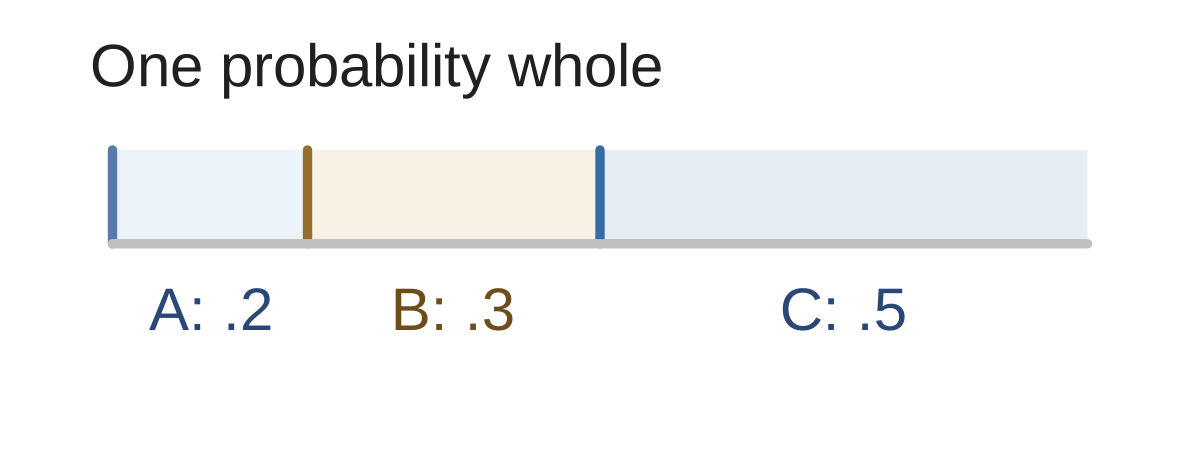
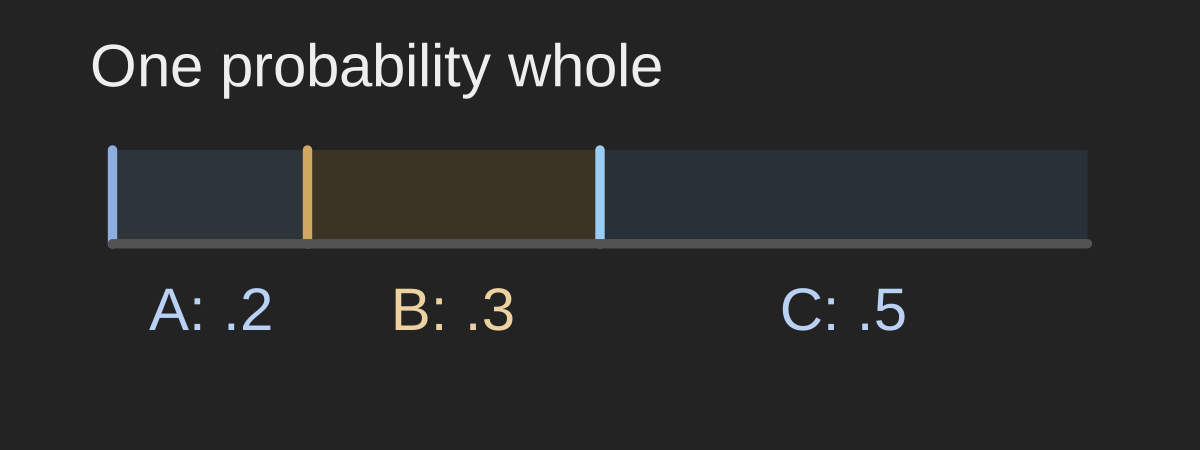
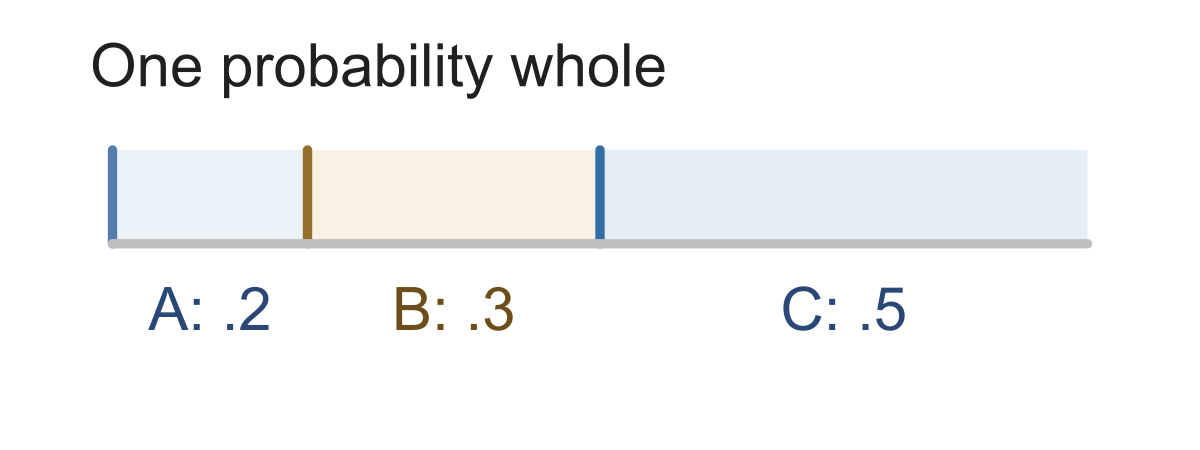
For A, B and C, masses 0.2, 0.3 and 0.5 pass both tests. The outcomes do not need equal masses.
Masses: 0.3, 0.3, 0.3. Check the assignment.
Show answer and explanation
Their total is 0.9.
02To fill one missing mass, subtract the known total from 1#
To fill one missing mass, subtract the known total from 1. If two masses are 0.2 and 0.6, they use 0.8, leaving 0.2.
A model returns exactly one of A, B, C. Their masses are 0.1, 0.6, ?. Find the missing mass.
Show answer and explanation
The missing mass is 1 − 0.7 = 0.3.
03Zero masses are allowed#
Zero masses are allowed. Negative masses are not: −0.1, 0.4 and 0.7 total 1 but still fail. Checking only the total misses this error.
Masses: -0.1, 0.2, 0.9. A learner says “total 1, so valid.” Correct?
Show answer and explanation
−0.1 is negative.
Check every mass and the complete total. Unequal masses and zero masses are allowed; negative masses and a total other than one fail.
Sources & further reading
- [1]Philip B. Stark, SticiGui: Probability, Axioms and Fundaments ↗Philip B. Stark, UC Berkeley · Book