Events
An event is a subset of a sample space and occurs when the observed outcome belongs to it.
On this page 7 sections
01An event is a subset of the sample space#
An event is a subset of the sample space. It occurs when the observed outcome belongs to that subset.
For S = {1, 2, 3, 4}, “greater than 2” selects 3 and 4. Either observed result makes the event occur.
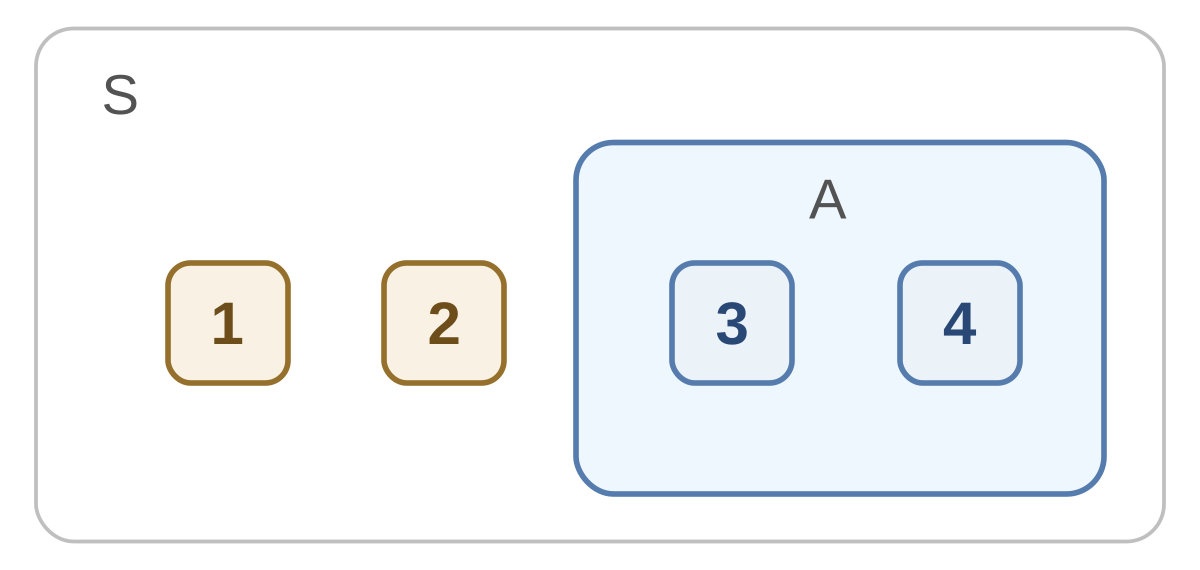
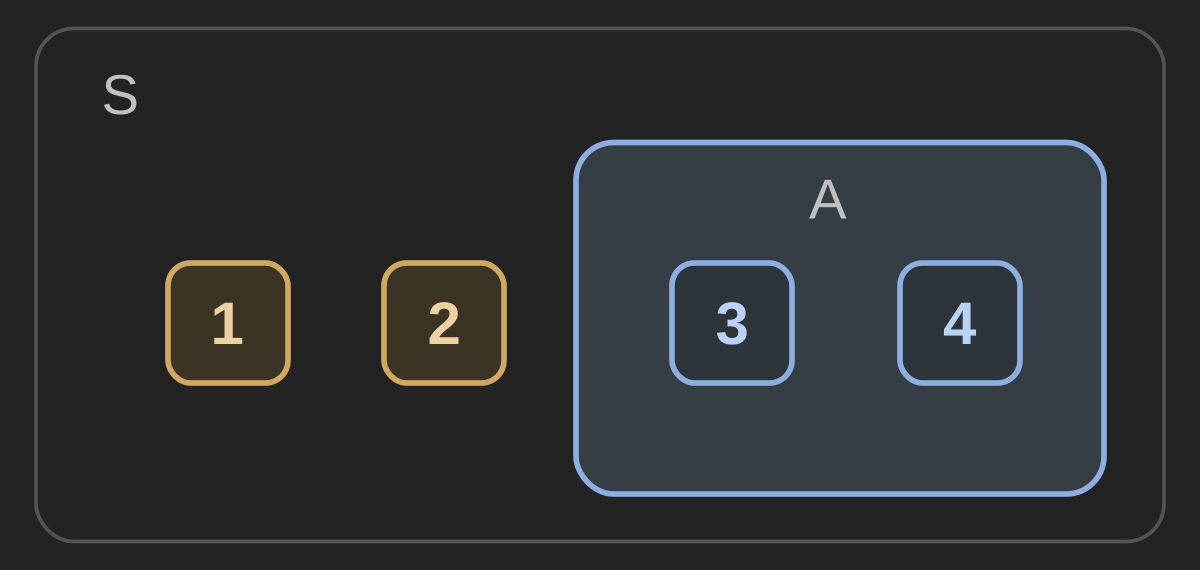
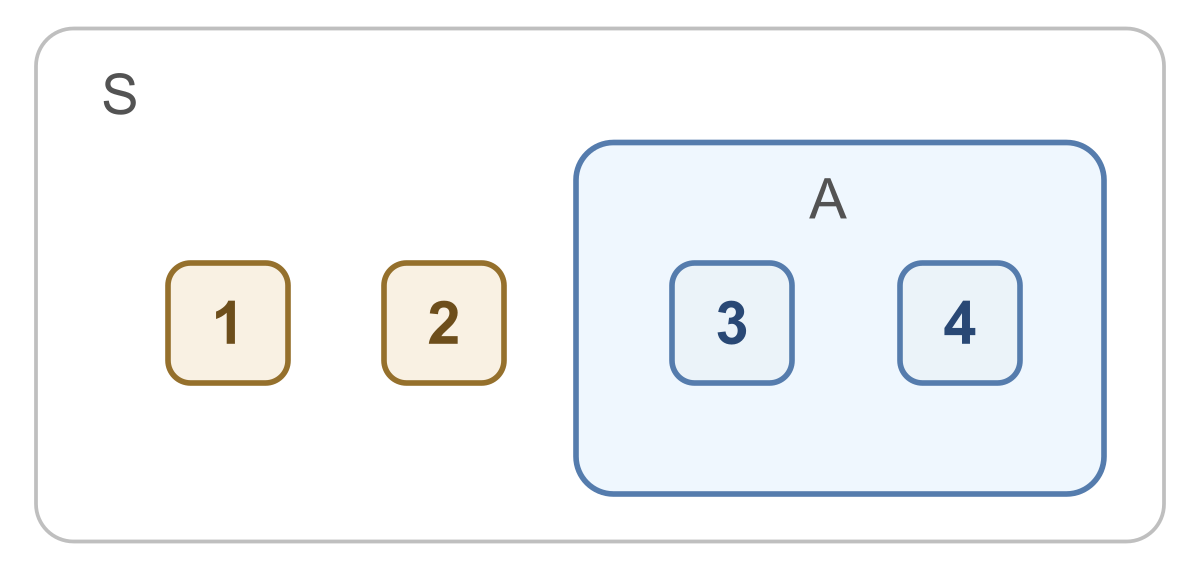
S = {1, 2, 3, 4}. Event: result < 3. Choose its subset.
Show answer and explanation
The qualifying outcomes are {1, 2}.
02Events can select records by several features#
Events can select records by several features. “Red AND square” keeps only records satisfying both conditions. Every included record must already belong to the sample space.
Records: u=red/round; v=red/square; w=blue/round. Event: red AND square. Select its IDs.
Show answer and explanation
v is red and square.
03The empty subset describes no qualifying outcome#
The empty subset describes no qualifying outcome. The whole sample space describes all of them. A single outcome, several outcomes, or either boundary can define an event.
S = {1, 2, 3}. Event: result ≥ 2. A learner chose {1}. Repair it.
Show answer and explanation
Keep {2, 3}; both are ≥ 2.
Translate the event into a membership test. Keep every outcome that passes, including none or all when appropriate.
Sources & further reading
- [1]Pishro-Nik, Introduction to Probability, 1.3.1 Random Experiments ↗Pishro-Nik, Introduction to Probability · Book