Confidence interval meaning
Confidence describes how often an interval-producing procedure covers a fixed population parameter under its stated sampling model.
On this page 8 sections
01Understand the idea#
A confidence interval comes from a procedure designed to cover a fixed population parameter at a stated rate across repeated samples. The sample changes, so the interval changes. This describes the procedure’s reliability; no particular observed interval is guaranteed to contain the truth.
A confidence procedure produces an interval from random sample data. Across repetitions, the interval changes while the population parameter stays fixed. Coverage means that the interval contains that fixed parameter.
At fixed target 4, the three interval outputs have the listed probabilities. The last two contain 4, including the endpoint of .
![At fixed parameter 4, three possible closed interval outputs are [1,3] with probability 1/4,[2,5] with probability 1/2, and[4,7] with probability 1/4. The first misses 4; the other two contain 4, including the endpoint 4. Their total probability is 3/4. All rows use the same horizontal numeric scale; the dashed parameter line remains fixed.](/visuals/s-confidence/number-line-90ejpj.svg)
![At fixed parameter 4, three possible closed interval outputs are [1,3] with probability 1/4,[2,5] with probability 1/2, and[4,7] with probability 1/4. The first misses 4; the other two contain 4, including the endpoint 4. Their total probability is 3/4. All rows use the same horizontal numeric scale; the dashed parameter line remains fixed.](/visuals/s-confidence/number-line-90ejpj-dark.svg)
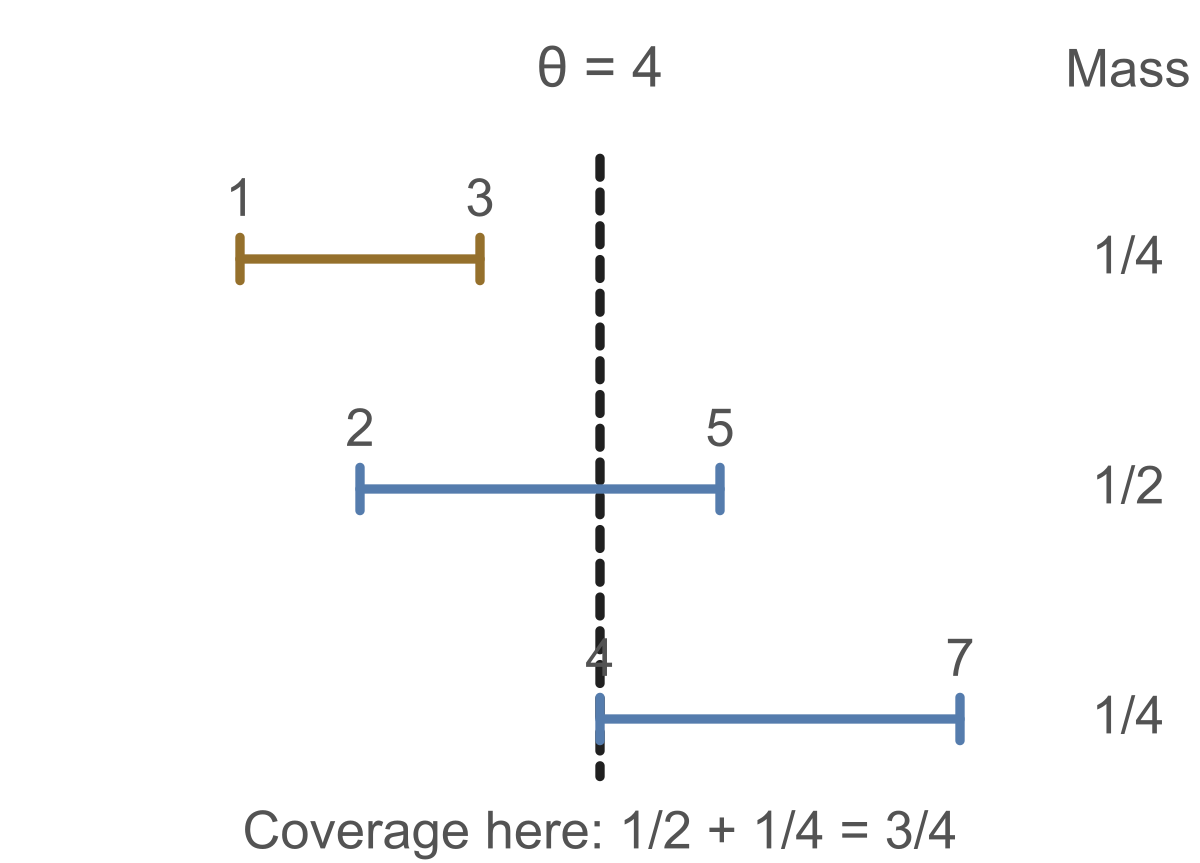
Fix a target at 4. An interval misses; covers; and closed interval also covers because an endpoint counts. If those three outputs have probabilities , add only the covering probabilities to get . The target stays 4 in every repetition.
At that target, coverage is . This calculation describes the supplied model at . A valid confidence guarantee must hold over the parameter values for which the procedure is claimed.
Fixed θ=3. All interval outputs and masses: [0,2]:0.4; [2,4]:0.2; [3,5]:0.4. Intervals are closed. Coverage here?
Show answer and explanation
Included masses: 0.2 + 0.4 = 0.6.
02A closer look#
In a simulation, a known target lets us mark each repeated interval as covering or missing. The target is shared across runs; it is not redrawn for each interval.
Simulation target θ=4. Runs: A[1,3]; B[3,6]; C[4,7]. Covered runs and target?
Show answer and explanation
B,C contain the same target 4.
03A closer look#
A 95% procedure describes repeated coverage, not a guaranteed count of 95 hits in every 100 repetitions. Once an interval is observed, it either contains the fixed target or does not; the target may remain unknown.
80% confidence interval: [4,9]. Fixed unknown target. “80% chance here.” Repair.
Show answer and explanation
Repeated coverage.
04A closer look#
For an estimated average model error, a confidence procedure describes repeated-sampling reliability under its assumptions. It is not the chance that an individual future error falls inside the interval. Prediction intervals answer that different question.
The interval varies across repeated samples; the parameter stays fixed. Confidence describes procedure coverage, not a new probability distribution for an observed fixed target.
- Interpret repeated coverage of a fixed parameter.
Sources & further reading
- [1]Pishro-Nik, Introduction to Probability, 8.3.1 General Framework of Interval Estimation ↗Pishro-Nik, Introduction to Probability · Book